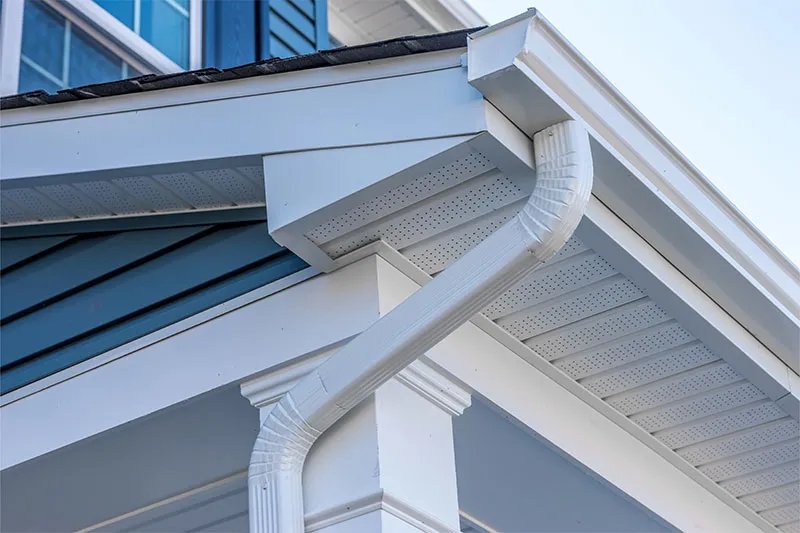
K-style vs half-round gutters is a choice between capacity and character. K-style gutters, with a flat back and a front shaped like crown molding, carry more water for their width and fit most New Jersey houses. Half-round gutters hold less, but they give older homes the profile those houses were built with.
Below, the two shapes are compared on what matters in this climate: how much rain they move, how they hang, how they handle snow, what they cost and where copper fits.
What is the difference between K-style and half-round gutters?
The shape, and everything that follows from it. A K-style gutter has a flat bottom, a flat back that sits against the fascia board and a decorative front edge. A half-round gutter is an open semicircle that rides in brackets. A University of Illinois building research guide notes that residential gutters are usually 5 or 6 inches wide.
| Point | K-style | Half-round |
|---|---|---|
| Shape | Flat back and bottom, molded front | Open semicircle |
| Capacity at the same width | Higher | Lower |
| How it hangs | Hangers hidden inside the gutter, fastened through the back into the fascia | Visible brackets on the fascia or straps under the roof edge |
| Look | A crisp line that reads as trim | A soft, rounded edge |
| Homes it suits | Colonials, ranches, split-levels and capes | Victorians, Tudors and other pre-war houses |
| Price in aluminum (HomeGuide, national) | Baseline | About $1 to $2 more per linear foot |
What does seamless mean for each style?
Seamless gutters are roll-formed from a coil of metal and cut to the length of each run, so a straight run has no joints. Englert, a gutter maker based in Perth Amboy, describes forming 5-inch K-style gutters from 11-3/4-inch coil and 6-inch gutters from 15-inch coil. Corners, outlets and end caps are still joined and sealed, so seamless does not mean leak-proof. If you choose half-round, ask how your runs will be made and joined.
Which gutter carries more water?
K-style does, at the same width. The University of Illinois guide calls the K-style (ogee) shape the most common partly because of its carrying capacity, and says half-round gutters have smaller capacity. A half-round system therefore often needs the next size up, or more downspouts, to drain the same roof.
New Jersey downpours make that a practical question. NOAA’s Atlas 14 puts the 10-year, 5-minute rainfall intensity near New Brunswick at about 6.3 inches per hour, with similar values in Toms River and Newton. Short bursts like that are when a small gutter spills over its front edge.
The Illinois guide also gives a quick test for 5-inch gutters. They are adequate only when downspouts are less than 30 feet apart, the roof pitch is 9:12 or less, and the roof area drained is less than the gutter length in feet times 30. Other roofs typically need 6-inch gutters. Our 5-inch vs 6-inch gutter guide works through examples.
Size the downspouts first
A common rule is one square inch of downspout opening for each 100 square feet of roof. By that rule a 2×3-inch downspout serves about 600 square feet and a 3×4-inch downspout about 1,200. Amerimax’s installation instructions rate the two sizes at 186 and 434 gallons per minute. Whatever gutter shape you pick, size the downspouts by roof area first and choose their style second.
Which gutter style fits your house?
Match the gutter to the architecture. K-style reads as part of the trim on most homes built from the 1950s on. Half-round looks at home on Victorians, Tudors, Colonial Revival houses and other pre-war homes, especially where the eave shows exposed rafter tails or a deep cornice.
New Jersey has plenty of those older houses. Census Bureau survey data shows about 17 percent of the state’s housing units were built in 1939 or earlier, and about 49 percent before 1970. In a local historic district, changing the gutters on a front facade may need review. Towns can form historic preservation commissions under New Jersey’s Municipal Land Use Law, and Princeton alone has 21 historic overlay districts. Ask your town before you trade half-round for K-style on a historic house.
How do the hangers differ?
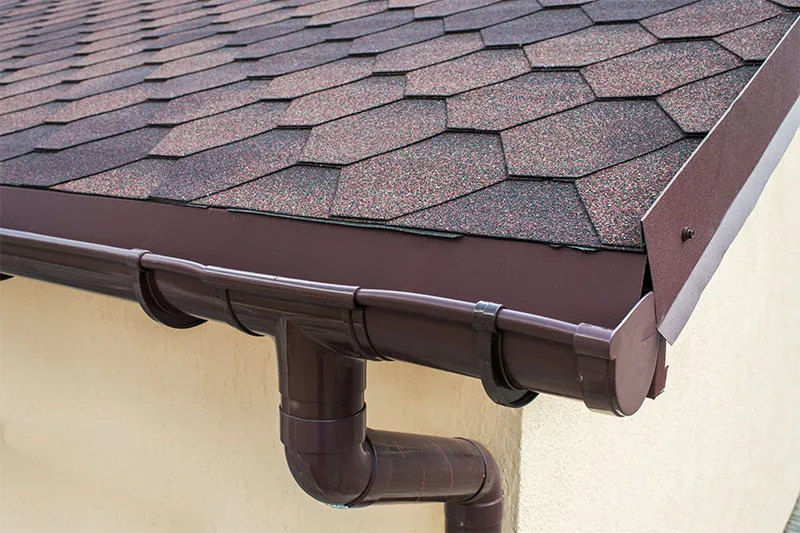
K-style gutters usually hang on hidden hangers that clip inside the front lip and fasten through the back into the fascia. Half-round gutters sit in brackets fastened to the fascia, or on straps tucked under the roof edge, so the hardware shows. On half-round, the bracket finish and spacing become part of the look.
Spacing matters more than hanger style. The University of Illinois guide calls for supports no more than 32 inches apart on aluminum and copper gutters, tightening to 16 to 24 inches where snow and ice sit for much of the winter. Runs longer than 40 feet need an expansion joint. In snow country, the gutter should also hang low enough that a straightedge laid on the roof clears its outer edge, so sliding snow does not pull it down.
Amerimax’s instructions slope a gutter about 1/4 inch for every 10 feet toward the downspout. Both styles hang on the fascia, so rotted fascia should be repaired before new gutters go up. Our soffit and fascia page covers that repair.
What do K-style and half-round gutters cost?
On price, K-style vs half-round gutters differ a little in aluminum and a lot in copper. HomeGuide’s 2026 guide puts professionally installed gutters at $12 to $25 per linear foot, with aluminum at $10 to $20, and says half-round styles add about $1 to $2 per foot. Angi lists seamless aluminum at $4 to $9 per foot for material plus $4 to $10 per foot for labor.
Copper changes the math. HomeGuide estimates copper gutters at $25 to $40 or more per linear foot installed, about $5,000 to $8,000 for 200 feet, while Angi lists seamless copper at $15 to $25 per foot with labor priced separately. All of these are national figures, and your exact price comes from a free measurement.
Are copper half-round gutters worth it?
For a period home you plan to keep, they can be. InterNACHI’s life-expectancy chart lists copper gutters at 50 years or more and copper downspouts at 100 years, against 20 to 40-plus years for aluminum gutters. Those are estimates that assume maintenance, not promises.
Copper comes with one firm rule: keep its runoff off certain metal roofs. Metal Sales’ Galvalume warranty excludes areas that receive runoff from copper, and DECRA’s stone-coated steel specification says not to use copper with its panels. On a house with a Galvalume or stone-coated steel roof, lay out the gutters so copper water never crosses those panels, or choose aluminum. Our copper half-round gutter page has the details.
Do gutter guards work on half-round gutters?
They can, if the guard is made for the half-round shape, so confirm the fit before you order. Your trees and your winter matter more than the gutter style. This Old House rates micro-mesh guards as highly effective against debris of all sizes, does not recommend reverse-curve helmets where snow and ice build up, and found that no guard is maintenance-free. Our gutter guards page compares the types.
So which should you choose?
- Choose K-style for the most capacity for the money and a clean trim line on a post-war house.
- Choose half-round for a pre-war home, a historic district or a house whose eaves call for a rounded edge, and size it up if the roof is large or steep.
- Choose copper half-round if you plan to stay for decades and copper water will not reach a Galvalume or stone-coated steel roof.
- With either style, size gutters and downspouts by roof area and pitch, not by looks.
Comparing K-style vs half-round gutters on paper only goes so far. Seeing both against your own roofline usually settles it, and our gutters overview covers the other options.
Get a free estimate
Or call (732) 231-5327.
Gutter style questions
Do half-round gutters hold less water than K-style gutters?
Yes, at the same width. A University of Illinois building guide notes that half-round gutters have smaller capacity than the K-style shape, so a half-round system often needs a larger size or extra downspouts to drain the same roof.
Are half-round gutters more expensive than K-style?
Slightly, in the same metal. HomeGuide’s national 2026 guide says half-round styles add about $1 to $2 per linear foot. Copper half-round costs far more; HomeGuide estimates copper gutters at $25 to $40 or more per foot installed.
Can copper gutters drain onto a metal roof?
Not onto Galvalume or stone-coated steel. Metal Sales excludes areas with copper runoff from its Galvalume warranty, and DECRA’s specification says not to use copper with its panels. Plan the layout so copper water stays off those roofs.
What size K-style gutter does a New Jersey home need?
HomeGuide says most homes use 5-inch K-style gutters, but larger or steeper roofs often need 6-inch. A University of Illinois guide limits 5-inch gutters to downspouts under 30 feet apart, pitches of 9:12 or less and a roof area under 30 times the gutter length.
Do half-round gutters work in snow and ice?
They can, when they are hung for it. The University of Illinois guide calls for supports every 16 to 24 inches where snow and ice stay much of the winter, and for hanging the gutter low enough that sliding snow clears its outer edge. The same rules apply to K-style.
Sources
- University of Illinois Building Research Council, Gutters and Downspouts for the Home
- Amerimax, gutter installation instructions
- NOAA National Weather Service, Atlas 14 precipitation frequency data
- Englert, seamless gutter catalog
- HomeGuide, gutter installation cost (2026); Angi, seamless gutter cost (2026)
- InterNACHI, life expectancy chart
- Metal Sales, Galvalume warranty; DECRA, Shingle XD specification
- This Old House, types of gutter guards
- U.S. Census Bureau, year structure built, New Jersey (ACS 2024)
- New Jersey Historic Trust, Preservation: A Tool for Municipalities; Princeton, Historic Preservation Commission
Gutters sized to your roof
See both gutter styles priced for your house
Tell us which look you are leaning toward. We measure the roof and every run and give you a written estimate.