Steel siding for central and northern New Jersey
Seamless Steel Siding for New Jersey Homes
Seamless steel siding runs each course across a wall in one long piece, so your house shows far fewer joints than standard lap siding. It suits owners who want a crisp painted look, a hard surface and a factory finish with written fade limits, and who accept that steel can dent.
- 5 on Google (12 reviews)
- Lifetime workmanship warranty for as long as you own the home
- Free written estimates
How it works
What is seamless steel siding?
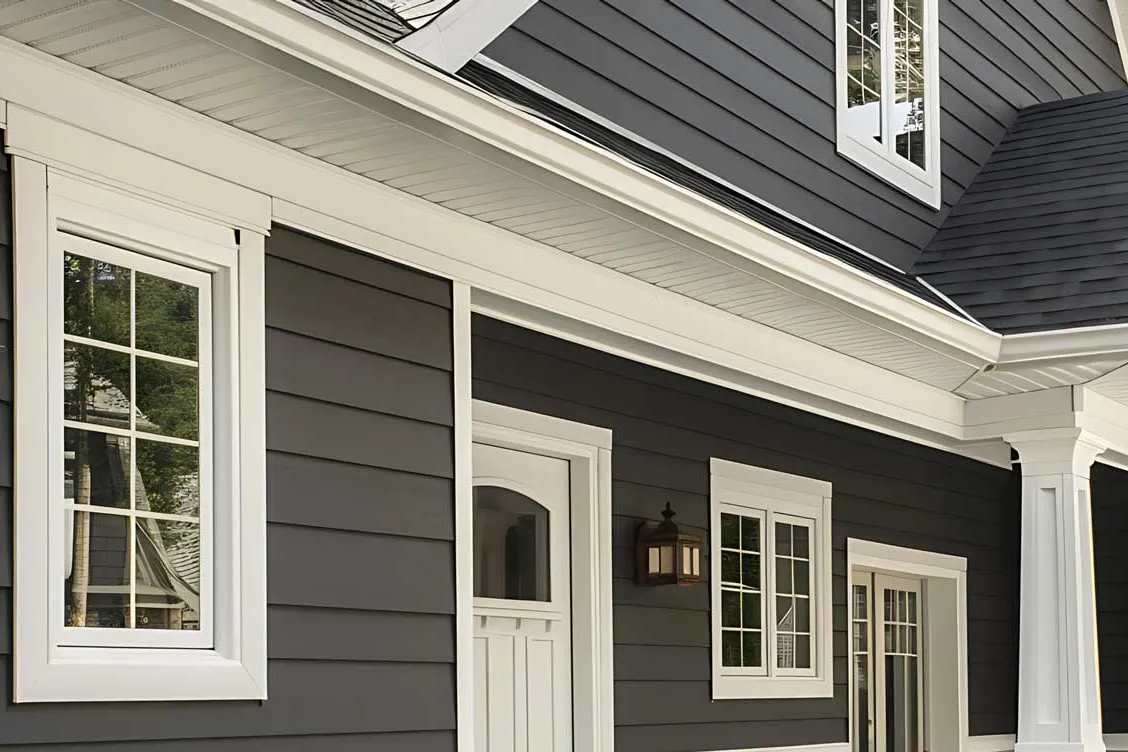
Seamless steel siding is painted steel lap siding cut to the length of each wall. Instead of short boards that overlap end to end, one piece spans the run, and the wall reads as long, unbroken lines.
Standard lap siding comes in fixed lengths, so each course has end laps where two pieces meet. Those laps show as small vertical lines across a wall, and on thicker vinyl they are easier to spot, according to the Journal of Light Construction. Seamless siding removes most of them.
Where do joints still happen?
Seamless does not mean jointless. Outside and inside corners, window and door trim, the starter strip at the bottom and the finish trim at the top all still meet the siding. Those spots are trimmed and flashed rather than lapped across the open wall, and they decide how well the wall sheds water.
Gauge and finish
What gauge and coating does steel siding use?
Residential steel siding is thin, galvanized and painted at the factory. On a spec sheet, look for the steel thickness, the coating standard and the paint resin. As one example, here is how Quality Edge specifies its steel siding.
| Item | Quality Edge published spec |
|---|---|
| Steel | 0.016-inch galvanized steel to ASTM A653 (TruCedar) |
| Heavier line | 0.020-inch steel on its Vesta panels |
| Paint | 50 percent PVDF (Kynar) on lap and board-and-batten; 70 percent PVDF (Kynar 500) on the shake profile |
| Impact | UL 2218 Class 4 |
| Flame spread | ASTM E84 Class A |
| Finish limits in the warranty | Chalk no more than 8 Hunter delta-E units; fade no more than 5 |
PVDF resins are marketed for color retention. MBCI, one metal maker, describes its PVDF finish as the premium choice for holding color and its silicone-modified polyester (SMP) finish as its most economical one. Ask which resin your quote includes and what the finish warranty says about chalk and fade, not only peeling.
What does the impact rating mean?
UL 2218 drops steel balls on a product and checks it for cracks. Class 4, the top class, means it withstood a 2-inch ball dropped from 20 feet; Class 3 uses a 1.75-inch ball from 17 feet. It is a lab test on a sample, not a promise that hail will never mark your walls.
Near salt water
Is steel siding warranted near the shore?
Often not within a set distance of salt water, so check before you choose. Quality Edge’s TruCedar warranty runs for the original homeowner’s lifetime on a residence, but it does not cover installations within 1,500 feet of salt water or salt spray.
That distance matters on the barrier islands and bay shore of Ocean County, along the Monmouth County coast and around Raritan Bay. Other makers set their own exclusions, and the wording differs from product to product. We read the warranty for your address with you before we quote steel.
The same warranty allows one transfer to a new owner, after which coverage becomes 50 years on the steel and the remainder of 35 years on chalk and fade. Salt air affects roofs too; our guide to metal roofs at the Jersey Shore covers that side. Read how manufacturer and workmanship warranties differ before you sign anything.
Dents and upkeep
Does steel siding dent, and how much upkeep does it need?
Yes, steel can dent, and a dent stays. Upkeep, on the other hand, is light: rinse the walls, watch the trim and touch up deep scratches.
Dents
A hard hit from hail, a ball or a ladder can leave a mark that does not spring back. Quality Edge’s warranty covers hail only up to class 3 and requires an insurance claim to be filed first. Fixing a visible dent usually means replacing the damaged course, and on seamless siding that course can run the full length of the wall.
Keep the product name, color and finish code from your contract. Those details make a matching replacement piece easier to order later.
Upkeep
Quality Edge says repainting should not be needed during its warranty. In practice, steel siding upkeep looks like this:
- Rinse the walls with a garden hose now and then, more often near the shore or under trees.
- Keep mulch, soil and firewood off the bottom course.
- Check trim, corners and sealant joints after big storms.
- Touch up scratches that reach bare metal with the maker’s touch-up paint and instructions.
Budget
What does seamless steel siding cost?
National guides put steel at the top of the siding price range. HomeGuide estimates $7 to $16 per square foot installed, against $4 to $12 for vinyl and $6 to $15 for fiber cement, plus $0.70 to $2.00 per square foot to remove old siding.
The same guide estimates 40 to 70 years of life for steel. These are national figures, not New Jersey prices. Trim, corners, lead-safe removal on older houses and any gutter or fascia work also move the total. Your exact price comes from a free measurement.
New siding is an exempt capital improvement for New Jersey sales tax when you give the contractor a completed Form ST-8, according to the NJ Division of Taxation.
Older homes and permits
What about older houses and permits?
On an older house, the work around the steel needs as much care as the steel. In a home built before 1978, EPA’s RRP rule covers paid work that disturbs more than 20 square feet of painted surface outside, so removing old painted siding or trim calls for lead-safe work practices.
The permit side is simpler. Under the NJ Uniform Construction Code, new siding on a detached one- or two-family house is ordinary maintenance and needs no construction permit. Historic districts and HOAs can still have a say. Our siding overview covers both rules in more detail.
Steel siding pairs well with a metal roof and new gutters, and a re-side is the natural time to fix rotted trim; see soffit and fascia. If steel is not the right fit, compare vinyl siding or fiber cement siding.
We give a written workmanship warranty on the installation, and the manufacturer warrants the steel and its finish. We work in ten counties across central and northern New Jersey; see our service areas.
Get a free estimate
Tell us about the house and the work. We visit, measure and give you a written price before any work starts.
Prefer to talk now? Call (732) 231-5327.
Seamless steel siding questions
Is seamless steel siding completely free of joints?
No. Each course can run the full length of a wall, but corners, windows, doors and the top and bottom of each wall still meet trim. Those joints are trimmed and flashed instead of lapped across the open wall.
How thick is steel siding?
It depends on the product. Quality Edge, for example, specifies 0.016-inch galvanized steel for its TruCedar siding and 0.020 inch for its Vesta line. Your written estimate should name the exact product and thickness.
Can steel siding go on a house near the ocean or bay?
It can, but read the warranty first. Quality Edge’s TruCedar warranty does not cover installations within 1,500 feet of salt water or salt spray, and other makers set their own limits. We go over the terms for your address before we quote.
What happens if hail dents steel siding?
A dent in steel stays. One maker’s siding is rated UL 2218 Class 4 in the lab, yet its warranty covers hail only up to class 3 and requires an insurance claim to be filed first. Fixing a visible dent usually means replacing the damaged course.
Will steel siding ever need painting?
Quality Edge says repainting should not be needed during its warranty, which sets chalk and fade limits on the finish. Plan on rinsing the walls now and then and touching up deep scratches the way the maker directs.
How long does steel siding last, and what does it cost?
HomeGuide’s national guide estimates 40 to 70 years of life and $7 to $16 per square foot installed. Those are national estimates, not New Jersey prices; your exact price comes from a free measurement.
Free estimate
Thinking about steel siding for your house?
We measure the walls, check the distance to salt water where it applies, and give you a written estimate that names the product, thickness and finish.
Call (732) 231-5327 or send the form.