Gutters and downspouts
Gutter Installation for New Jersey Homes
Gutter installation in NJ is about more than a channel at the roof edge. A gutter system that is sized, sloped and hung correctly moves roof water away from your foundation, basement walls and fascia, through summer downpours and winter ice. We install seamless aluminum gutters, gutter guards and copper half-round gutters, on their own or with a new roof.
- 5 on Google (12 reviews)
- Lifetime workmanship warranty for as long as you own the home
- Free written estimates
Why gutters matter
What does a gutter system do for a New Jersey house?
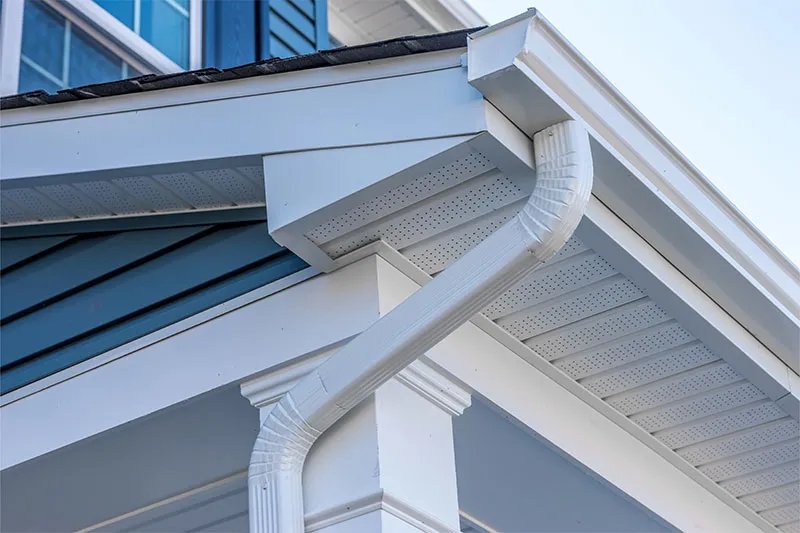
A gutter system catches the water running off your roof and hands it to downspouts that release it away from the house. Without one, that water falls along the drip line. It splashes the siding, soaks the soil beside the foundation and looks for a way into the basement.
The volume surprises most people. One inch of rain on 1,000 square feet of roof is roughly 620 gallons of water (1,000 square feet times one-twelfth of a foot, at about 7.5 gallons per cubic foot). The Office of the New Jersey State Climatologist puts average yearly precipitation at about 40 inches along the southeast coast and about 51 inches in north-central New Jersey.
A working system protects four parts of the house:
- Foundation and basement. Downspouts carry water away from the footing instead of dumping it against the wall.
- Fascia and soffit. A gutter that overflows or pulls away soaks the fascia board it hangs on, and wet wood rots.
- Siding, windows and doors. Less splash-back on the walls and fewer drips across entries.
- Walks and steps. Water leaves at a few planned points, so fewer drips refreeze on paths in winter.
Age raises the stakes. About 61 percent of New Jersey housing units were built before 1980, and about 17 percent in 1939 or earlier, according to the Census Bureau’s 2024 American Community Survey. On older houses the fascia behind the gutter has taken years of weather, so we check the wood before anything new goes up.
Our gutter services
Which gutter service fits your house?
Most houses need one of three systems, each with its own page.
Seamless aluminum gutters
Formed from coil to the length of each run, in 5-inch or 6-inch K-style, with downspouts sized to the roof area that drains into them.
Gutter guards
Micro-mesh, screens, reverse-curve helmets, brush and foam, compared honestly on debris, snow and upkeep.
Copper half-round gutters
The rounded copper profile for older and historic homes, with a long life estimate and real limits on which roofs it can drain onto.
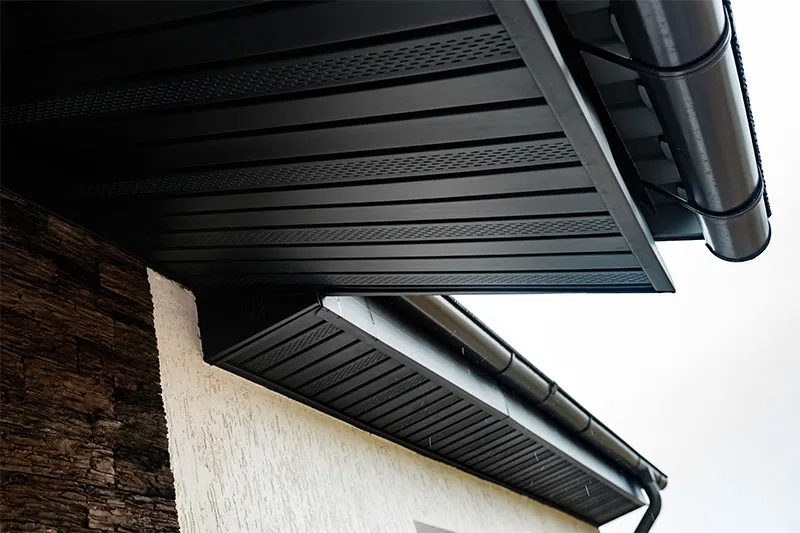
Gutters hang on the fascia, so we also repair and replace soffit and fascia, including vented soffit for attic airflow.
Seamless vs sectional
Are seamless gutters better than sectional gutters?
For most houses, yes. Seamless gutters are formed from a coil of metal to the length of each run, so a straight run has no joints along its length. Sectional gutters come in stock lengths that are spliced together on the house, and each splice is a joint to seal.
Englert’s seamless gutter catalog describes portable machines that roll-form flat coil and cut it to each run, and its specification calls for one continuous length on each elevation. Corners, outlets and end caps are still joined and sealed. Seamless means far fewer joints, not zero.
| Feature | Seamless | Sectional |
|---|---|---|
| Joints along a straight run | None | One at every splice |
| Joints that remain | Corners, outlets, end caps | Splices plus corners, outlets, end caps |
| How it is made | Formed from coil to each run’s length | Stock lengths cut and joined |
| Cost difference (HomeGuide) | About $3 to $5 or more per linear foot above sectional | Lower up front |
Sizing
What size gutters does a New Jersey house need?
Most houses take 5-inch or 6-inch K-style gutters. A 5-inch gutter suits smaller, simpler roofs. Large, steep or complex roofs usually need 6-inch gutters and bigger downspouts.
The University of Illinois guide to gutters and downspouts says a 5-inch gutter is adequate only when three things are true. The downspouts are less than 30 feet apart, the roof pitch is 9:12 or less, and the roof area draining into the gutter is less than its length in feet times 30. Otherwise it points to 6-inch.
Downspouts follow the same logic. The Illinois guide allows roughly a square inch of downspout area for each 100 square feet of roof. That makes a 2×3-inch downspout good for about 600 square feet and a 3×4-inch for about 1,200.
Our seamless gutters page covers gauges, slope and hangers, and our guide to 5-inch vs 6-inch gutters works through the sizing math.
Guards
Do gutter guards stop clogs?
Guards cut down how often gutters clog, but none of them make gutters maintenance-free. This Old House found in its testing that every type still needs some upkeep.
Micro-mesh blocks the most debris but needs precise fitting. Screens let pine needles through. Reverse-curve helmets are a poor match where snow and ice build up. Our gutter guards page compares every type with national costs.
Copper
When do copper half-round gutters make sense?
Copper half-round gutters suit older and historic houses where the gutter is part of the trim. InterNACHI’s life expectancy chart lists copper gutters at 50 years or more, against 20 to 40-plus years for aluminum. Those are estimates, not guarantees.
Copper has one hard limit: some metal roof makers forbid copper touching or draining onto their panels. Metal Sales’ Galvalume warranty excludes areas that get runoff from copper, and DECRA’s stone-coated steel specification rules out copper with its system. If your roof is metal, we check before we quote copper.
Details are on our copper half-round gutters page and in our guide to K-style vs half-round gutters.
Snow and ice
How do gutters hold up to New Jersey snow and ice?
Gutters do not cause ice dams and cannot stop them. Ice dams start with heat leaking from the house, which melts snow high on the roof. That meltwater turns back to ice at the cold eave, the sequence the University of Minnesota Extension lays out.
The cure is in the attic: air sealing, insulation and roof ventilation fed by vented soffits, per DOE’s Building America Solution Center. That is why our soffit and fascia work and our gutter work go together.
What a gutter can do is survive winter. The Illinois guide recommends supports no more than 32 inches apart for aluminum and copper, closing to 16 to 24 inches where snow and ice stay for much of the winter. It also says to set the gutter low enough that a straightedge laid on the roof clears its outer edge, so sliding snow does not tear it loose.
That matters most in the northern counties, where the State Climatologist puts average snowfall at 40 to 50 inches a year. On a metal roof, where snow can slide off in sheets, we plan the snow guards and the gutter line together. Our ice-dam guide goes deeper.
Roof and gutters together
Should you replace gutters when you replace the roof?
Often, yes. A roof replacement disturbs the eave, which is exactly where the gutter hangs. Doing both at once means one crew, one contract and one set of details where the roof edge meets the gutter.
The University of Illinois guide says the back of the gutter should sit under the drip edge or gutter apron. With one crew, that lap is planned rather than patched.
The paperwork is simpler, too. New Jersey requires every home improvement contract over $500 to be written and signed, under N.J.S.A. 56:8-151. One contract can list the roof, the gutters, the downspouts and any fascia repair, with one price.
Sales tax works the same way for both. The NJ Division of Taxation counts new gutters, like a new roof, as a capital improvement free of sales tax once the homeowner hands the contractor a signed Form ST-8. Repairs stay taxable, per Tax Topic Bulletin S&U-3.
Planning a new roof? See metal roofing or roof replacement, and ask for gutters on the same estimate.
Cost
How much does gutter installation cost in New Jersey?
National cost guides put professionally installed gutters at about $12 to $25 per linear foot. No published source gives a New Jersey figure, so your exact price comes from a free measurement of your house.
| Item | National range | Source |
|---|---|---|
| Installed gutters, all types | $12 to $25 per linear foot; $2,200 to $5,000 for an average home | HomeGuide, 2026 |
| Aluminum gutters, installed | $10 to $20 per linear foot | HomeGuide, 2026 |
| Seamless aluminum | $4 to $9 per linear foot for material, plus $4 to $10 for labor | Angi, 2026 |
| Gutter guards, installed | $15 to $45 per linear foot | HomeGuide, 2026 |
| Copper gutters, installed | $25 to $40 or more per linear foot | HomeGuide, 2026 |
| Downspouts | $30 to $75 each | HomeGuide, 2026 |
What moves the price is mostly footage. HomeGuide says most homes have 100 to 200 linear feet of gutter. It adds $1 to $2 per foot for 6-inch gutters, $1 to $3 per foot for a second story, and $50 to $200 to remove old gutters. Rotted fascia found behind old gutters adds repair work.
How we work
How does a gutter installation job run?
- We measure each run, the roof area that drains into it, and the condition of the fascia.
- You get a written estimate listing gutter size, metal thickness, color, downspouts, guards and any fascia repair.
- Old gutters come off, and rotted fascia is repaired before anything new is hung.
- New gutters go up sloped toward each outlet, with hangers spaced for snow and downspouts that release water away from the house.
- We clean up and walk the finished job with you.
Our process page explains the contract and your rights in detail. We give a written workmanship warranty, and the material makers warranty their products; our warranty page explains both.
Our workmanship warranty is a lifetime warranty: it covers our installation work for as long as you, the homeowner who signs the contract, own the home. It does not transfer to a later owner. Materials and paint finishes carry their manufacturers' own warranties, and the full written warranty comes with every estimate so you can read it before you sign.
Get a free estimate
Tell us about the house and the work. We visit, measure and give you a written price before any work starts.
Prefer to talk now? Call (732) 231-5327.
Gutter installation questions
Do I need 5-inch or 6-inch gutters?
It depends on the roof. A University of Illinois guide says 5-inch is adequate only when downspouts are less than 30 feet apart, the pitch is 9:12 or less, and the roof area is under the gutter length times 30. Bigger, steeper or complex roofs usually need 6-inch. We measure before we recommend a size.
Will gutter guards mean I never clean my gutters again?
No. This Old House testing found no guard is maintenance-free. Guards stretch the time between cleanings, but debris still collects on top or inside and needs occasional removal.
How long do gutters last?
InterNACHI’s life expectancy chart lists aluminum gutters at 20 to 40-plus years, copper gutters at 50-plus years and galvanized steel at 20 years, assuming regular maintenance. These are estimates, not guarantees.
Do new gutters cost sales tax in New Jersey?
Not when they are a capital improvement and you give the contractor a completed Form ST-8, according to the NJ Division of Taxation. Gutter repairs are taxable.
How often should gutters be checked?
A University of Illinois guide recommends inspecting gutters at least twice a year, in spring and fall, and more often under heavy tree cover.
How much does gutter installation cost in NJ?
National guides put installed gutters at about $12 to $25 per linear foot, or $2,200 to $5,000 for an average home (HomeGuide, 2026). There is no published New Jersey figure. Your exact price comes from a free measurement.
Free gutter estimate
Get your gutters measured and priced
We measure every run and downspout, check the fascia, and give you a written price before any work starts.
Call (732) 231-5327 or send the form. We serve ten counties in central and northern New Jersey; see our service areas.