Siding for central and northern New Jersey
Siding Contractor for New Jersey Homes
Hiring a siding contractor in NJ starts with one decision: seamless steel, vinyl or fiber cement. We help you weigh cost, upkeep and looks against your house, its age and where it sits, then put the whole job in writing before work starts.
- 5 on Google (12 reviews)
- Lifetime workmanship warranty for as long as you own the home
- Free written estimates
Three materials
Which siding fits a New Jersey house?
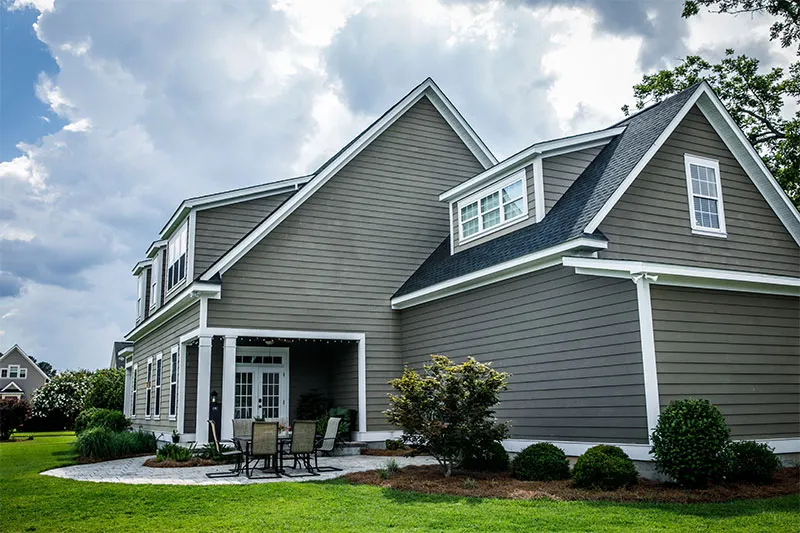
We install three sidings: seamless steel, vinyl and fiber cement. The right one for you depends on your budget, the upkeep you will accept, the look you want and how close you live to salt water.
The age of the house matters too. The Census Bureau’s 2024 American Community Survey shows about 61 percent of New Jersey homes were built before 1980, and about 17 percent before 1940. Older walls often hide rot, uneven sheathing and lead paint, so the prep work can shape the choice as much as the siding does.
Seamless steel
Painted steel lap siding cut to the length of each wall, so long walls show few end joints. One maker’s spec rates it Class A for flame spread and Class 4 for impact, but steel can still dent. Seamless steel siding
Vinyl
The lowest installed cost of the three in national guides. Thickness and third-party certification separate a solid panel from a flimsy one, and insulated versions add a modest R-value. Vinyl siding
Fiber cement
Heavy, rigid boards that read like painted wood clapboard. They come primed for field paint or with a factory finish, and the board and the finish carry separate manufacturer warranties. Fiber cement siding
Side by side
How do steel, vinyl and fiber cement compare?
Steel has the highest installed range in national cost guides and vinyl the lowest. Fiber cement sits between them on price and has the longest estimated life. The table sets the published numbers side by side.
| Seamless steel | Vinyl | Fiber cement | |
|---|---|---|---|
| Thickness or gauge | 0.016 in. galvanized steel in one maker’s spec (Quality Edge) | 0.035 in. minimum for certification; most pros use about 0.042 in. or thicker (JLC) | Set by each product line; we show you the spec sheet |
| Upkeep | Wash it and touch up deep scratches; the maker says repainting should not be needed during its warranty | Low upkeep, not zero: color can fade in direct sun and boards can crack in big temperature swings | Wash it and check caulked joints; primed boards must be field-painted |
| Finish warranty, as the maker states it | Quality Edge: residential coverage for the original owner’s lifetime, with chalk and fade limits; no coverage within 1,500 ft of salt water | Varies by maker; read the written warranty for the product quoted | James Hardie: 15-year limited warranty on its ColorPlus factory finish, separate from the 30-year limited warranty on the board |
| Installed cost, national (HomeGuide) | $7 to $16 per sq ft | $4 to $12 per sq ft | $6 to $15 per sq ft |
| Estimated life (HomeGuide) | 40 to 70 years | 30 to 40 years | 50 to 75 years |
HomeGuide adds $0.70 to $2.00 per square foot to remove old siding. Our guide to vinyl, fiber cement and steel siding walks through the trade-offs at more length.
Two warranties protect a siding job. We give a written workmanship warranty on the installation, and the manufacturer warrants the siding and its finish. Our warranty page explains how the two fit together.
Budget
What does new siding cost in New Jersey?
National cost guides put most siding jobs at about $4 to $13 per square foot installed. HomeGuide translates that to roughly $10,000 to $32,500 for what it calls a 2,500-square-foot house. We know of no reliable New Jersey-only siding price data, so treat these figures as a starting point.
What moves your number:
- Wall area and the number of stories
- How many layers of old siding come off, and the condition of the sheathing underneath
- Windows, doors and corners that need trim, plus any rotted wood to replace
- Soffit, fascia and gutters added to the same job
- Lead-safe setup and clean-up on houses built before 1978
- The material, profile, thickness and color you pick
New siding is also an exempt capital improvement under New Jersey sales tax rules. Hand the contractor a filled-in Form ST-8 and the job carries no sales tax, according to the NJ Division of Taxation. Siding repairs are taxable. Your exact price comes from a free measurement at the house.
Older homes
How does lead-safe siding work on a pre-1978 house?
If your house was built before 1978, removing old siding or painted trim is usually lead-paint work under federal rules, with containment and careful clean-up.
EPA’s Renovation, Repair and Painting (RRP) rule covers paid work that disturbs paint in homes built before 1978. Outside, only jobs that disturb 20 square feet of painted surface or less are exempt as minor repair, and a full re-side is far larger. Covered work needs an EPA-certified firm, certified renovators and lead-safe work practices, and EPA enforces the rule in New Jersey.
New Jersey’s Rehabilitation Subcode adds limits for pre-1978 painted surfaces unless the paint tests lead-free. It bars open-flame burning, heat guns above 1,100 degrees F, uncontained power washing, and dry scraping or sanding of 10 square feet or more per building outside (N.J.A.C. 5:23-6.4). Power sanding and blasting are allowed only with a HEPA vacuum attachment.
We plan pre-1978 jobs around both sets of rules. Before work starts on an older house, ask any contractor you are weighing for its EPA lead-safe firm certificate.
Weather
How do wind and moisture change the siding choice?
In New Jersey, the layers behind the siding matter as much as the siding, because wind drives rain into every gap. A sound wall needs a weather barrier, flashing at each window, door and roof-to-wall joint, and siding fastened to hold through a storm.
The Office of the New Jersey State Climatologist says coastal storms, often called nor’easters, are most frequent from October to April. Rarely does a winter pass without at least one significant one. Average yearly precipitation runs from about 40 inches on the southeast coast to about 51 inches in north-central New Jersey.
Wind
New Jersey does not publish one design wind speed for the whole state. DCA Bulletin 19-1 tells designers to pull wind values for each address from ASCE 7 hazard tools. Vinyl certification includes a wind load test, and we fasten every product to its maker’s printed instructions.
Salt air
Near the shore, the warranty decides as much as the material does. Quality Edge does not warrant its steel siding within 1,500 feet of salt water or salt spray. Other makers set their own terms, so we read the warranty for the exact product and address before we quote.
Rot and trapped water
Water that gets behind old siding rots sheathing, sills and trim. Once the old siding is off, we check the wood before covering anything, and the estimate states how repairs are priced.
One trip up the ladder
Should soffit, fascia and gutters be done with the siding?
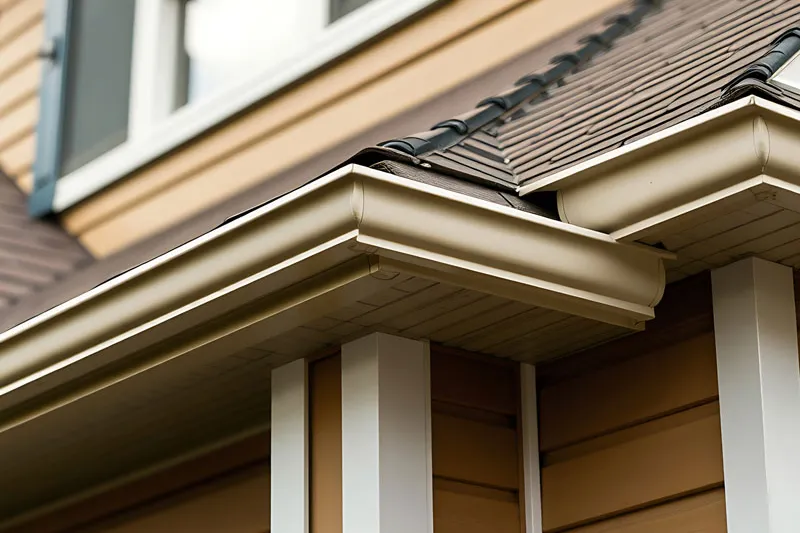
Usually, yes. Gutters hang on the fascia, and the fascia and soffit close off the roof overhang, so a re-side is the practical moment to fix all three.
Fascia is the board on the rafter ends where gutters hang. Soffit closes the underside of the overhang, and vented soffit lets fresh air into the attic as warm air leaves near the ridge. Rotted fascia should be repaired before it is capped or a gutter goes back on it.
Aluminum trim coil can be bent on site to cap wood fascia and window and door casings; CertainTeed, for one, sells 0.019-inch painted aluminum coil for that job. HomeGuide puts soffit and fascia replacement at $9 to $34 per linear foot for both, and installed gutters at $12 to $25 per linear foot (national estimates).
Read more about soffit and fascia repair, gutter installation and seamless gutters. If the roof is near the end of its life too, plan it with the siding; our metal roofing page covers that part of the house.
Permits and paperwork
Do you need a permit to replace siding in New Jersey?
Not for most houses. Under the NJ Uniform Construction Code, replacing existing siding on a detached one- or two-family home is ordinary maintenance, and ordinary maintenance needs no construction permit (N.J.A.C. 5:23-2.7). The exceptions:
- Polypropylene siding: repairing or replacing it is not ordinary maintenance and always needs a permit.
- Attached townhouses and multifamily buildings: like-for-like siding replacement counts as ordinary maintenance only up to 25 percent of the total exterior wall area.
- Structural or fire-safety work: never ordinary maintenance.
- Historic districts and HOAs: a town historic preservation ordinance can require review of exterior changes, and HOA rules may limit colors and materials. The permit exemption overrides neither.
The contract matters as much as the permit. New Jersey requires a written, signed contract for home improvement work over $500, and you can cancel until midnight of the third business day after you receive your copy. Our process page shows what goes into ours.
How we work
What happens on a siding job with us?
- We visit, measure the walls and check the trim, gutters and soft wood.
- You get a written estimate naming the material, profile, color, trim and the plan for the gutters.
- Old siding comes off, damaged wood is repaired, the wall is wrapped and flashed, and the new siding and trim go on.
- We clean up, walk the house with you and hand over the warranty paperwork.
Our workmanship warranty is a lifetime warranty: it covers our installation work for as long as you, the homeowner who signs the contract, own the home. It does not transfer to a later owner. Materials and paint finishes carry their manufacturers' own warranties, and the full written warranty comes with every estimate so you can read it before you sign.
We install siding in ten counties, from Sussex in the north to Ocean at the shore. Find yours on our service areas page, or ask us if your town sits just outside them.
Get a free estimate
Tell us about the house and the work. We visit, measure and give you a written price before any work starts.
Prefer to talk now? Call (732) 231-5327.
Siding questions from New Jersey homeowners
Which siding lasts longest on a New Jersey house?
HomeGuide’s national cost guide estimates 50 to 75 years for fiber cement, 40 to 70 years for steel and 30 to 40 years for vinyl. Those are estimates that assume normal upkeep, not promises, and the house, the installation and the exposure all play a part.
Do I need a permit to replace siding in NJ?
Not on a detached one- or two-family house: the state code treats replacing existing siding there as ordinary maintenance. Polypropylene siding is the exception and always needs a permit, attached and multifamily buildings follow a 25 percent rule, and historic districts or HOAs may want their own approval.
Is siding removal on an older house treated as lead paint work?
On a house built before 1978, usually yes. EPA’s RRP rule covers paid work that disturbs more than 20 square feet of painted surface outside, and stripping old siding or painted trim typically disturbs far more than that. The work then has to follow lead-safe practices.
Should the gutters come down when the house is re-sided?
In most cases they do. Gutters hang on the fascia, so re-siding is the natural time to repair or cap the fascia and then rehang the old gutters or put up new seamless ones. Doing it in one visit avoids paying twice for the same ladder work.
Do I pay New Jersey sales tax on new siding?
Not when you give the contractor a completed Form ST-8. The NJ Division of Taxation treats new siding as an exempt capital improvement; the contractor still pays tax on the materials it buys. Siding repairs are taxable.
Which siding holds up near salt water?
Read the product warranty before you choose. Quality Edge, for example, does not warrant its steel siding within 1,500 feet of salt water or salt spray. Before we quote a house near the bay or ocean, we go over those terms for your address with you.
Free siding estimate
Want a written price for new siding?
Tell us about the house. We measure the walls, check the trim and gutters, and give you a written estimate for the material you choose.
Call (732) 231-5327 or send the form.