Our flagship roof system
Standing Seam Metal Roofs on New Jersey Houses
Standing seam metal roof systems in NJ are built from long steel or aluminum panels that lock together at upright ribs. The clips and their screws sit under the ribs, so nothing pierces the panel face. Below is each decision that shapes one, and what it changes in price and performance.
- 5 on Google (12 reviews)
- Lifetime workmanship warranty for as long as you own the home
- Free written estimates
The basics
How is a standing seam roof put together?
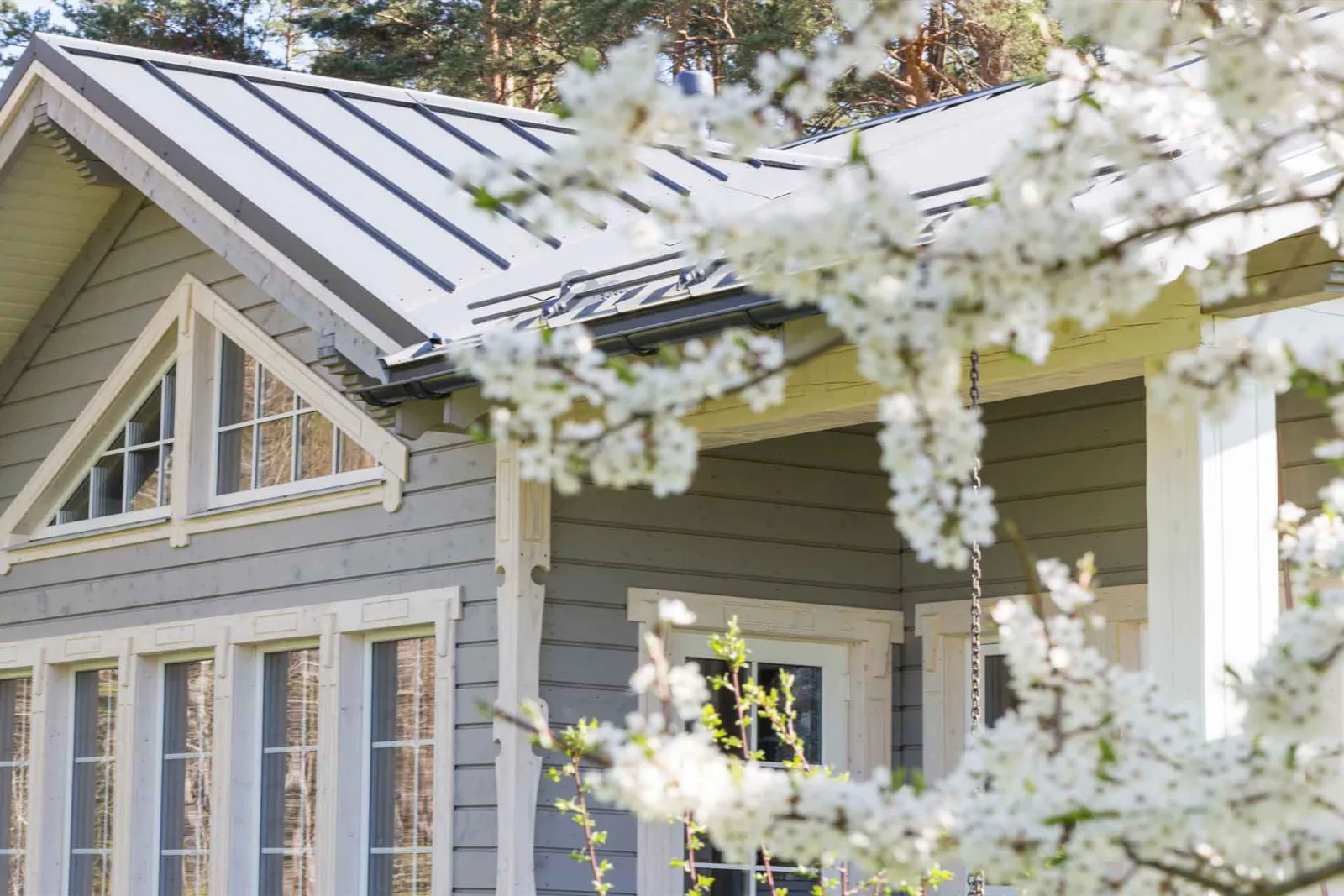
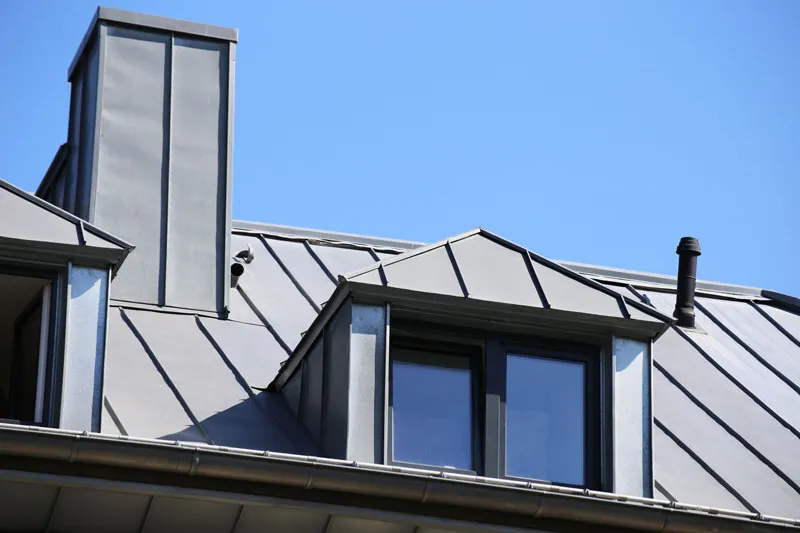
Vertical panels run down the slope, and their edges turn up and interlock above the flat field of each panel, called the pan. Rain travels down the pans while the joints sit high and dry.
Clips fastened to the deck grip each rib, so nothing punches through the pan. On most house roofs one panel can reach from eave to ridge without a break, leaving no end laps where water could creep in.
Rib height and panel width set the look. A taller rib keeps the joint higher above running water. Narrow pans add lines and stay flatter; wide, flat pans show oil canning, a cosmetic ripple in the metal, more readily.
Seam types
Which seam type fits your roof: snap-lock or mechanical?
Snap-lock ribs click together by hand and cover most steep house roofs well. Mechanical ribs are crimped shut by a seaming machine run along them up on the roof, which suits flatter pitches and deep snow.
Sheffield Metals lists 2/12 as the lowest pitch for its snap-lock profiles. Its mechanical profile, 1.5 inches tall, carries the same 2/12 rating, or 1/12 on steel when sealant goes into the seam and conditions allow. Sheffield’s steep-slope advice aims snap-lock at roughly 3/12 through 7/12 and cautions that its ribs are more prone to disengaging as built-up snow and ice move, so it steers snowy climates toward mechanical seam.
| Feature | Snap-lock | Mechanical seam |
|---|---|---|
| How the rib closes | Clicks together by hand | Crimped by a seaming machine on the roof |
| Lowest pitch (Sheffield ratings) | 2/12 | 2/12; 1/12 on steel with in-seam sealant |
| Snow and ice | The maker cautions ribs can let go as snow shifts | The maker’s pick for snowy climates |
| Labor | No seaming pass | Extra seaming pass, so it usually costs more |
The model code floor for standing seam is a pitch of 1/4 inch per foot (2024 IRC text, R905.10), yet plenty of makers ask for more. That is why every roof plane gets its pitch measured before we quote. Shallow porch roofs and the snowy northwest are where the mechanical upcharge pays off.
Panel thickness
Is 24 or 26 gauge steel right for your house?
24 gauge is the heavier sheet, since smaller gauge numbers mean thicker steel; it resists dents, holds a flatter pan and costs more. 26 gauge is cheaper and common on porches and simple roofs. For a garage or shed, screw-down corrugated panels are another route.
Coastal homes
Should a house near salt water get Galvalume or aluminum?
Away from the coast, Galvalume-coated steel does the job. Close to surf, bays or salt marsh, read the panel warranty first; many leave those spots out.
Metal Sales warrants its AZ55 Galvalume panels for 45 years against perforation under normal atmospheric conditions. The coverage stops, though, for roofs closer than 1,500 feet to salt water or exposed to marine air or salt spray. Sheffield Metals describes common Galvalume exclusions ranging from 400 feet of a marsh shoreline and 800 feet from a big bay up to 1,500 feet of a coast with breaking surf.
Around here, that sweeps in oceanfront blocks and homes near Raritan Bay, Barnegat Bay and the back-bay marshes of Monmouth and Ocean counties, where rust-proof aluminum is the standard answer. See metal roofs at the Jersey Shore.
That warranty also excludes water draining off copper flashing or pipes, and direct contact with copper. Pairing a Galvalume roof with copper half-round gutters means detailing the eave so the two metals never touch.
Paint finishes
PVDF or SMP paint, and how do you read a paint warranty?
PVDF keeps its color longer and costs more; SMP, a silicone-modified polyester, costs less. PVDF often goes by Kynar 500, a trade name Arkema uses for the resin.
MBCI positions its 70% PVDF Signature 300 for color retention and its SMP Signature 200 as the lowest-cost option. It says each carries 30 years of colorfastness and 40 years of film integrity coverage, with coastal terms possibly different.
Look past the big number. According to Sheffield Metals, PVDF paint usually has film adhesion terms of 20 to 40 years but chalk and fade terms of just 10 to 30, varying with color. A 40-year SMP headline normally means film adhesion alone. Ask for the written terms for your color and address.
Under and around the panels
What goes under the panels, and what holds them down?
Each standing seam roof we put on gets full underlayment across the deck, in a type the panel maker approves, and a self-adhered eave membrane along the edges.
State code demands an ice barrier only in places whose January average sits at 25 degrees F or below, and DCA Bulletin 07-3 names Sussex County as that place. We fit the eave membrane in every county regardless. If tear-off turns up rotted decking the contract does not cover, the repair goes in a signed change order, as state law requires for contract changes.
Fixed and floating clips
Fixed clips pin a panel down; floating clips let it slide as the steel stretches in July sun and pulls back on January nights. Long panels usually pair one fixed zone with floating clips everywhere else. Spacing comes from the maker’s instructions and from wind and snow loads set for your exact lot, as DCA Bulletin 19-1 directs.
Snow guards
Snow guards keep the snowpack on the roof to melt slowly rather than dumping in one slab. We place them over doors, paths, decks, the driveway, lower roofs and gutters. S-5! says its rib clamps hold snow guards without any roof penetration and keep roof warranties intact.
Ventilation
Metal does not change the attic’s air needs; attic heat is the root of ice dams, per University of Minnesota Extension. Standing seam takes a vented ridge fed by soffit intake, and our soffit and fascia service handles clogged or rotted soffits. Also see our ice-dam guide.
Approvals
Is a permit or historic approval required for standing seam?
No construction permit is required on a freestanding one- or two-family house, because the state code classes a roof covering swap there as ordinary maintenance (the ordinary-maintenance rule). Attached homes generally need a permit.
Historic review runs on its own track, and the permit exemption does not cancel it (New Jersey Historic Trust). Princeton’s Historic Preservation Commission weighs applications across 21 overlay zoning districts under Historic Design Guidelines adopted in September 2026. The Morristown commission serves as an adviser to the town’s boards. Where an HOA or district says no to vertical ribs, metal shingles or metal tile may get through. Our roof permit guide covers the rest.
Installation
What does a standing seam install look like, day by day?
Nearly every house roof follows the same sequence. How many days it takes hinges on size, pitch, layers, complexity and weather, and the contract states start and finish dates, as state home improvement regulations require.
- Contract: you sign, and you may still cancel up to midnight of business day three after receiving your copy.
- Tear-off: plantings shielded, old roofing stripped to bare wood, decking inspected.
- Dry-in: drip edge, eave membrane and underlayment against rain.
- Flashing: valleys, walls, chimneys, skylights and plumbing vents.
- Panels: clips screwed down, panels set, ribs snapped or machine-crimped.
- Finish: ridge, vent, trim, snow guards and any contracted gutter work.
- Clean-up: debris hauled away, nails swept up, a walk-around with you.
Our process page lays out the whole path from first call to final payment.
Price
How are standing seam metal roofs priced in New Jersey?
Begin with national numbers. HomeGuide (November 2025) prices installed standing seam between $9 and $16 a square foot, or about $13,500 up to $40,000 on a typical house. HomeAdvisor (June 2026) cites an average close to $19,000 and says most homeowners pay between $9,400 and $32,600.
These are countrywide figures, not local quotes; we set your number after a free measurement. Size, pitch, layers, valleys, chimneys, skylights, gauge, metal, paint and rib type all shift it.
Every roof gets priced from a measurement at the house, with the total in the written estimate.
On sales tax, a full roof replacement counts as a capital improvement, which New Jersey leaves untaxed once the owner fills out Form ST-8 for the contractor (bulletin S&U-3). Our metal roof cost guide runs a sample calculation.
Get a free estimate
Tell us about the house and the work. We visit, measure and give you a written price before any work starts.
Prefer to talk now? Call (732) 231-5327.
Side by side
How does standing seam compare with asphalt and metal shingles?
Standing seam costs more than architectural asphalt but is built to outlast it by a wide margin; metal shingles price a little lower and look traditional.
| Feature | Standing seam | Architectural asphalt | Metal shingles |
|---|---|---|---|
| Look | Long vertical lines | Dimensional shingle | Shake, slate or shingle profiles |
| Fasteners | Concealed under the ribs | Nailed, covered by the next course | Concealed in the interlock |
| Snow | Lets go fast; guards over doors | Holds snow longer | Textured faces hold snow longer |
| Solar mounting | Clamps on the ribs, no drilling | Mounts bolt through into the rafters | Varies by system |
| Typical life | Decades; one maker warrants Galvalume 45 years against perforation | An average of 15 to 30 years, per a Copper Development Association estimate | Decades, depending on metal and paint |
| National installed cost | $9-$16 a sq ft (HomeGuide) | Usually the lowest upfront | $6-$14 a sq ft (HomeGuide) |
The asphalt range comes from the Copper Development Association. Read metal roof vs shingles for the full head-to-head, or asphalt shingle roofing if shingles suit your budget better.
Warranty
Which warranties back a standing seam roof?
Our written workmanship warranty covers the installation, while the manufacturers stand behind the metal and the paint.
Our workmanship warranty is a lifetime warranty: it covers our installation work for as long as you, the homeowner who signs the contract, own the home. It does not transfer to a later owner. Materials and paint finishes carry their manufacturers' own warranties, and the full written warranty comes with every estimate so you can read it before you sign.
State rules make any contract above $500 spell out its warranty, so your terms live in the contract you sign. Our warranty page explains claims and what can void coverage. Solar later? Mounts clamp onto the ribs; see solar-ready roofs. We work with your solar installer but do not install panels.
Standing seam questions we hear in New Jersey
What lifespan should I expect from standing seam?
Several decades, given the right metal, paint and installation. Metal Sales warrants its Galvalume panels 45 years against perforation, and MBCI quotes 40 years of film integrity coverage; both list exclusions.
Which seam handles snow better?
Mechanical seam. In Sheffield Metals’ view, snap-lock ribs are more prone to disengaging as built-up snow and ice move, so it points snowy climates toward mechanical seam.
Will standing seam work on a nearly flat porch roof?
Often. Code permits standing seam down to 1/4 inch per foot, though every panel has its own rating; Sheffield’s mechanical profile is rated for 2/12 (1/12 on steel with in-seam sealant).
Is aluminum worth it for a shore or bay house?
Usually. Metal Sales does not warrant its Galvalume panels closer than 1,500 feet to salt water, and common industry exclusions reach bay and marsh frontage too. Aluminum cannot rust; we check its warranty terms for your address.
Is an ice and water membrane required under a metal roof in New Jersey?
Code requires one in Sussex County alone, per DCA Bulletin 07-3. Every standing seam roof we install gets a self-adhered eave membrane anyway.
Does standing seam need a construction permit?
Not on a freestanding one- or two-family house, where a roof covering swap is ordinary maintenance. Attached homes generally need one; historic districts may add review.
Could standing seam be installed over the shingles I have now?
Sometimes, depending on the existing layers, the deck and what code and the panel maker permit. Our page on metal roofs over shingles walks through the trade-offs.
What price range should I expect for standing seam?
HomeGuide lists installed standing seam between $9 and $16 a square foot, and HomeAdvisor cites a national average close to $19,000. Both are nationwide figures; a free measurement sets your actual price.
Free estimate
Get a written price for a standing seam roof
We measure each roof plane, go over rib type, gauge, metal and color with you, and commit the total to paper.
Call (732) 231-5327 or send the form. We cover ten counties; see our service areas.