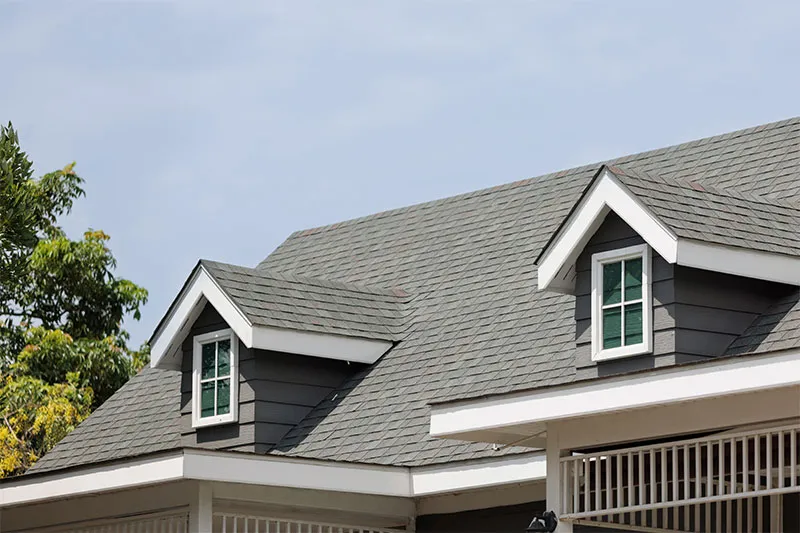
Do you need a roof replacement permit in NJ? On a freestanding house with one or two dwelling units, usually not. The state’s Uniform Construction Code files a re-roof of that house under ordinary maintenance, a category that skips both the construction permit and any notice to the construction official. The answer changes for attached homes, bigger buildings, structural repairs and local historic districts.
What follows summarizes published state rules; it is not legal advice. On your particular house, the local construction official decides.
When is a roof replacement permit not needed in New Jersey?
When two things are true. The house stands apart from its neighbors (the rule’s word is detached) and holds one or two families, and the work swaps out the roof covering it already has. Section N.J.A.C. 5:23-2.7 of the state’s construction rules lists that job as ordinary maintenance. It can be carried out with no permit application and no advance notice to the construction office.
Siding gets similar treatment. On one- and two-family homes, fixing or swapping out the existing siding is also ordinary maintenance, apart from one material covered below.
Superstorm Sandy is where this started. The DCA’s Construction Advisory Board recorded in its 2013 minutes that roofing and siding permits had been suspended during the recovery, and a later rule change locked the exemption in. Town notices give the effective date as March 5, 2018.
The rule refers to the roof covering in general terms rather than naming shingles or metal. If the plans reach further, such as new rafters or a reshaped roof, call the construction office before anyone starts.
Which roofing and siding jobs still need a permit?
Anything outside that narrow lane: roofs on attached or larger buildings, structural or fire-safety work, and polypropylene siding.
Attached homes, multifamily and commercial buildings
Townhouses and other attached homes, apartment buildings and commercial properties are missing from the roofing line of the ordinary-maintenance list. Re-roofing them therefore generally calls for a construction permit. Because that conclusion rests on what the list omits, confirm it with the construction office for your address.
Those buildings get a narrower siding allowance too. Re-siding them with like material stays ordinary maintenance only until the work reaches a quarter of the building’s total exterior wall area.
Work that affects structure or fire safety
The same section says ordinary maintenance never covers work touching structural or fire safety. Rebuilding rafters, adding framing or reshaping the roof takes the job out of the exemption.
Roof decking, the plywood or boards beneath the roofing, is the gray zone. Your local construction official decides whether swapping a few damaged sheets counts as structural. If the attic shows rot or soft spots, ask before the job.
Polypropylene siding
Polypropylene is the siding exception on one- and two-family homes. Fixing or replacing it falls outside ordinary maintenance, so it takes a permit. If you cannot tell vinyl from polypropylene on your walls, have it identified before the job is quoted. Our siding page covers the materials we install.
| Job | Construction permit? | Where the rule is |
|---|---|---|
| New roof covering on a freestanding one- or two-family house | No, ordinary maintenance | N.J.A.C. 5:23-2.7 |
| New roof covering on a townhouse, apartment or commercial building | Generally yes; confirm locally | Left off the ordinary-maintenance list |
| Siding repair or replacement on a one- or two-family house | No, ordinary maintenance | N.J.A.C. 5:23-2.7 |
| Polypropylene siding repair or replacement | Yes | N.J.A.C. 5:23-2.7 |
| Like-for-like siding on other buildings | No, until it reaches a quarter of the exterior walls | N.J.A.C. 5:23-2.7 |
| Rafters, framing, other structural or fire-safety work | Yes, never ordinary maintenance | N.J.A.C. 5:23-2.7 |
| Swapping damaged roof decking | Ask your construction official | Turns on the structural call |
| Exterior change in a designated local historic district | Town review may apply with no permit | Local ordinance (Municipal Land Use Law) |
Can the new roof go over the old one?
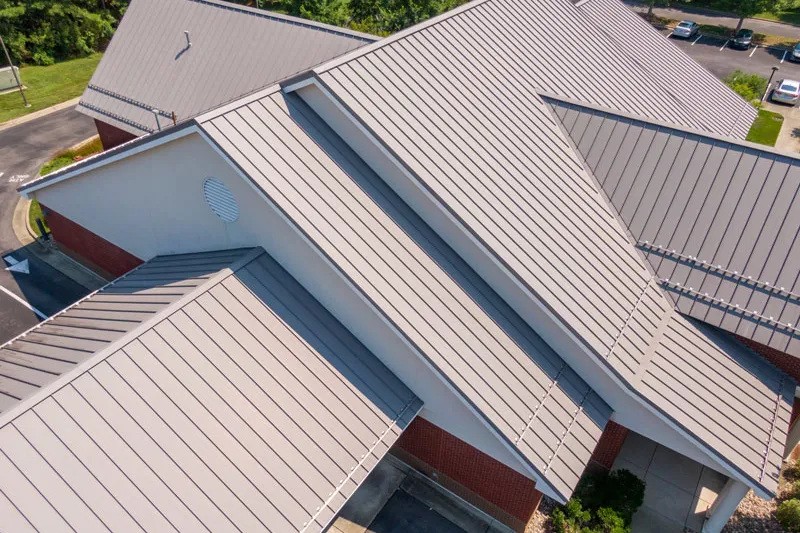
Only over one sound layer. New Jersey’s Rehabilitation Subcode, in N.J.A.C. 5:23-6.4(e)7, spells out when the old roof covering has to be stripped before a new one is installed. Permits and tear-offs are separate questions, and our estimates apply the tear-off list to every roof, permit or not. A full strip is required if:
- the current roof is soaked through or too far gone to act as a base;
- it is covered with wood shakes, slate, or clay, cement or asbestos-cement tile; or
- two or more layers of roofing are already on the house.
In practice, that allows at most one old layer under a new roof, and only when that layer and the deck below it are sound. The model code carves out complete, separate roof systems, such as standing seam panels that carry their loads to the structure. New Jersey’s text omits that carve-out, so do not assume metal gets a pass on extra layers.
The panel maker’s instructions also have to permit a roof-over. Our metal-over-shingles page explains when one makes sense.
Did the 2024 codes change anything for re-roofing?
The code books changed. The 2024 International Residential Code, International Building Code and other model codes took effect here on August 17, 2026, with state amendments. That date comes from the DCA rule adoption.
That adoption amended the subcode sections, N.J.A.C. 5:23-3.14 to 3.22. The ordinary-maintenance list lives in a different section, 5:23-2.7, and the tear-off list lives in the Rehabilitation Subcode. If your job does need a permit, ask which edition will apply. DCA describes a six-month window after adoption when applicants can generally pick the prior code.
Two more state rules affect roofers. Code ties the eave ice barrier to areas where January’s average daily temperature runs 25 degrees F or colder, and DCA Bulletin 07-3 says that means Sussex County. We put an eave membrane on as standard practice in every county we serve anyway. And under DCA Bulletin 19-1, snow and wind design values are looked up for each address in hazard tools built on ASCE 7, not taken from one statewide number.
Do historic districts need to approve a new roof?
They can, even with no construction permit in play. The Municipal Land Use Law allows a New Jersey town to pass a preservation ordinance, map local historic districts and set up a preservation commission. A New Jersey Historic Trust guide reports that in most towns with such an ordinance, major exterior work inside a designated district goes through a review. That review is tied either to the construction permit or to a certificate of appropriateness.
Skipping the construction permit does not skip the historic review. How much review you face depends on the town:
- Princeton (Mercer County) has designated 21 historic overlay zoning districts. Its preservation commission reviews development applications inside them, and in September 2026 it adopted new design guidelines.
- Morristown (Morris County) has a seven-member preservation commission, and the town’s page describes it as advisory, not as a gatekeeper for every exterior change.
- Haddonfield, in Camden County, sits at the strict end. Owners in its Historic District must get a Certificate of Appropriateness, issued by the Planning Board, before changing a building’s exterior.
Being listed on New Jersey’s register of historic places or the National Register is a separate matter. The Historic Trust guide calls it generally honorific for a private property, and the binding rules come from local ordinances. In an older neighborhood, ask the town whether your street falls in a locally designated district before you settle on a material or color.
How do you check with your municipal construction office?
Call or email your town’s construction office, often listed as the building department, with your address and a one-line job description. Have these answers ready so the office can give you a clear yes or no:
- Is the house detached, or does it share a wall with a neighbor?
- Is it a one- or two-family home, or does it have more units?
- What comes off and what goes on: roof covering only, or decking, rafters or framing too?
- How many roof layers are on the house now?
- If siding is part of the job, is it vinyl, polypropylene, wood or something else?
- Is the property in a local historic district or under a homeowners association?
Ask the historic-district question even when no permit is needed, since that review may sit with planning or zoning.
If a permit is required, New Jersey’s home improvement rules say the contractor may not start work until it is issued. The contractor must also hand you copies of required inspection certificates before final payment is due, under N.J.A.C. 13:45A-16.2. Our guide to your home improvement contract rights covers the rest of that rule.
What does this mean for your project?
For most freestanding single-family and two-family houses, the document that matters most is the contract, not a permit. At the estimate visit we count the roof layers, look at the deck from the attic and note anything structural, so you know before signing what the job involves.
Where a permit or a historic review applies, the written contract says so, and work starts after approval. Our installation process page shows each step.
A tax note: with Form ST-8 in hand, replacing the whole roof qualifies as an exempt capital improvement under the Division of Taxation’s rules, while repairs stay taxable. National price ranges are on our cost guide for metal roofs, and your exact price comes from a free measurement.
Get a free estimate
Or call (732) 231-5327.
Roof permit questions
Is a construction permit required to re-roof a single-family house in NJ?
Usually not, as long as the house stands on its own. N.J.A.C. 5:23-2.7 classes a new roof covering on a freestanding one- or two-family house as ordinary maintenance, which needs neither a permit nor a notice. Structural work and local historic review are the main exceptions.
Does a townhouse roof replacement need a permit in NJ?
Generally yes. Townhouses, apartment buildings and commercial properties are left off the roofing line of the ordinary-maintenance list, so a permit is generally needed. Confirm with your town’s construction office, and check your association’s rules too.
Is a permit needed to replace rotted roof decking?
It depends. Anything touching structural safety falls outside ordinary maintenance, and your local construction official decides whether a deck repair qualifies. Ask before the job if the attic shows rot or soft spots.
Can a new roof go over my old shingles without a permit?
Permits and tear-offs are separate questions. The Rehabilitation Subcode orders a full strip when the house already carries two or more layers, or when the roof is wood shake, slate or tile. It also requires one when the old roof is too worn or wet to act as a base, which leaves room for a roof-over on one sound layer at most.
Does my historic district have to approve a new roof?
It may. Towns can create historic districts and commissions through the state’s land use statute, and most local ordinances require a review of major exterior work inside them. Ask your town first, before picking a material or color, permit or no permit.
Sources
- NJ Department of Community Affairs: adoption notice for the 2024 codes, Rehabilitation Subcode text, ice barrier bulletin 07-3, design load bulletin 19-1
- DCA Construction Advisory Board, minutes covering 2008 to 2013
- N.J.A.C. 5:23-2.7, ordinary maintenance rule, via Cornell’s legal information site
- New Jersey Historic Trust, municipal preservation guide
- Town preservation commission pages: Princeton, Morristown, Haddonfield
- N.J.A.C. 13:45A-16.2, contractor practices rule, via Cornell’s legal information site
- NJ Division of Taxation, contractor tax bulletin S&U-3
Planning a roof replacement
Know what your roof needs before you sign
We count the layers, check the deck and tell you in writing whether a tear-off, a deck repair or a permit is part of the job.