Recover or tear off
Metal Roof Over Shingles: What New Jersey Allows
A metal roof over shingles is allowed in New Jersey in one case only: a single layer of asphalt that is still sound, on a deck that is still sound. This page explains the state’s tear-off rule, how we check a roof before suggesting a recover, what goes between the old and new roofs, and the honest pros and cons.
- 5 on Google (12 reviews)
- Lifetime workmanship warranty for as long as you own the home
- Free written estimates
The rule
Can you put a metal roof over shingles in New Jersey?
Yes, but only over one layer of asphalt shingles that is dry and sound. In every other case New Jersey requires a full tear-off, and its rule makes no exception for metal.
The requirement comes from N.J.A.C. 5:23-6.4(e)7, a section of the state’s Rehabilitation Subcode (NJ DCA rule text). It requires removing the existing covering before a new one goes on when any of these is true:
- The roof already has two or more layers of any roof covering.
- The existing covering is wood shake, slate, clay tile, cement tile or asbestos-cement tile.
- The existing roof is water-soaked or too deteriorated to serve as a base for the new one.
Many articles online quote the national model code instead. Section R908.4 of the 2024 International Residential Code exempts complete standing seam systems that carry their loads straight to the structure, and allows metal over wood shakes covered with gypsum board (model code text).
New Jersey’s rule does not repeat those exceptions. We follow the state text, and we check unusual cases with the local construction official.
The panel maker has a say as well. Its installation instructions must permit a recover, and they set the underlayment and fastening details.
Before we say yes
How do we check whether your roof can take a recover?
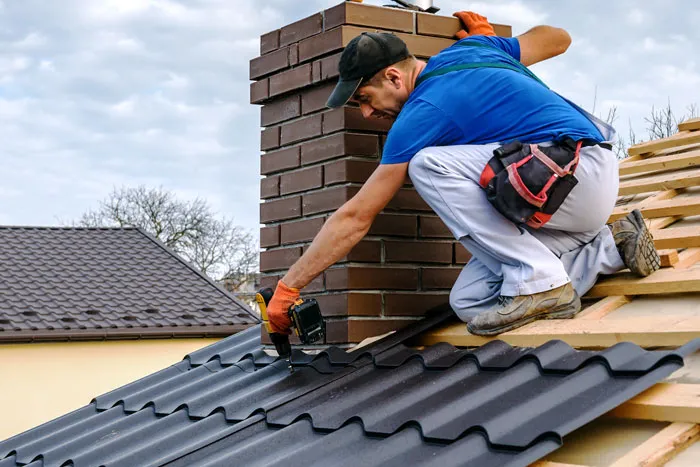
We count the layers, look at the deck from the attic and walk the roof for soft spots. If any check fails, the answer is a tear-off.
Counting layers
Layers usually show at the roof edge, along a rake or at a vent opening. Two shingle layers, or shingles laid over old wood shakes, rule out a recover under the state rule.
The deck from below
From the attic, dark stains, damp or flaking sheathing, rusted nail tips and daylight between boards all point to moisture or leaks. A deck in that shape may no longer qualify as a sound base.
The surface from above
Spongy spots underfoot, a roofline that sags between rafters, and shingles that are badly curled or buckled all argue against covering them. Flat metal pans show what is underneath, so lumps can read through.
Weight
Weight is usually not the deciding factor. Figures published by Classic Metal Roofing Systems, which makes metal roofing, put a square of steel roofing (100 square feet) at 80 to 125 pounds and a square of asphalt shingles at 275 to 425. The Metal Roofing Alliance says metal can often go over an old asphalt roof without added reinforcement.
Between the layers
What goes between the old shingles and the new metal?
Either a new underlayment laid over the shingles, or a grid of wood battens that gives the metal a flat base to fasten to. The panel maker’s instructions decide which one its system allows.
Underlayment over shingles
A new underlayment separates the metal from the old asphalt and sheds any water that gets past a flashing. Its type must be one the panel maker approves for a recover.
Battens or furring strips
Battens are wood strips fastened through the old roof into the deck or rafters. They even out an uneven surface and suit some metal shingle and panel systems. They also raise the roof edge, so trim, drip edge and gutter positions must be planned around the added height.
Flashing, vents and edges
The metal roof gets its own new flashing at walls, chimneys, skylights and plumbing vents. The attic still needs air, so the ridge needs an exhaust vent fed by intake at the soffits, as the model code’s ventilation section (2024 IRC R806) describes.
State rules require a written contract over $500 to describe the work and the main materials (N.J.A.C. 13:45A-16.2). On a recover we price, the estimate names the method, the underlayment and the flashing.
Trade-offs
What are the pros and cons of a metal roof over shingles?
A recover saves the cost and mess of a tear-off. It also leaves most of the deck unseen and uses up the one layer New Jersey allows you to cover.
| Factor | Metal over one layer | Tear-off, then metal |
|---|---|---|
| Removal cost | None | About $1 to $3 per sq ft (HomeGuide) |
| Debris | Little to haul away | All old roofing hauled away |
| Deck | Judged from the attic and the surface | Fully exposed and repaired as needed |
| Underlayment and eave membrane | Laid to the panel maker’s recover details | Laid straight onto the bare deck |
| Finished surface | Lumps in the old roof can show through | Flat, even deck under the panels |
| Next re-roof | Both layers must come off | One layer to remove |
Pros
- No tear-off charge, which HomeGuide puts at about $1 to $3 per square foot on a metal roof job.
- Less debris, and the old shingles stay on as a backup layer while the work goes on.
- The tear-off step drops out, which can shorten the job.
Cons
- Hidden deck damage can stay hidden until it shows up as a leak or a soft spot.
- An uneven old surface can telegraph through flat metal pans.
- The next roof will need a full tear-off of both layers.
- Not every panel system allows a recover, and the eave and rake details get more involved.
Permits and approvals
Does a recover change the permit picture?
On a detached one- or two-family home, New Jersey’s ordinary-maintenance rule covers repairing or replacing the roof covering, which needs no construction permit (N.J.A.C. 5:23-2.7). Attached homes generally need a permit either way.
If you want written confirmation for a recover, ask the local construction official. Historic districts and HOAs may also review a switch from shingles to metal, with or without a tear-off; the New Jersey Historic Trust explains how local reviews work. Our roof permit guide has more.
Choosing the system
Which metal roofs can go over shingles?
Standing seam and metal shingle systems can both be designed for a recover when the maker’s instructions allow it. The system you pick changes how flat the old roof needs to be.
Standing seam
Long panels with hidden clips. The flat pans need an even base, so battens or a very flat old roof matter more. See standing seam roofs.
Metal shingles and shakes
Smaller interlocking pieces whose texture can hide minor unevenness. The model code minimum slope for metal shingles is 3:12. See metal shingles.
Garages and sheds
On an outbuilding, screw-down corrugated panels are a simpler route, with yearly screw checks.
Near salt water, check the panel warranty first. The Metal Sales Galvalume warranty, for one, excludes roofs within 1,500 feet of salt water. Shore owners can start with our Jersey Shore metal roof guide.
For budgeting, HomeGuide’s national ranges are $9 to $16 per square foot installed for standing seam and $6 to $14 for metal shingles. Skipping the tear-off removes the removal line, but your exact price comes from a free measurement. See the metal roof cost guide and our metal roof vs shingles comparison.
Ask how a recover affects the panel and paint warranties before you sign. Our warranty page explains our workmanship warranty and the makers’ coverage.
Get a free estimate
Tell us about the house and the work. We visit, measure and give you a written price before any work starts.
Prefer to talk now? Call (732) 231-5327.
Questions
Metal over shingles: questions we hear
Is it legal to put a metal roof over shingles in New Jersey?
Yes, if the roof has just one layer of asphalt shingles and both the shingles and the deck are sound. N.J.A.C. 5:23-6.4(e)7 requires a tear-off when there are two or more layers, wood shake, slate or tile, or a deteriorated roof.
Does New Jersey make an exception for standing seam over two layers?
No. The national model code exempts some standing seam systems, but New Jersey’s rule does not repeat that exception, so two existing layers must come off.
Do I need battens to put metal over shingles?
It depends on the panel system. Some systems use wood battens over the old roof; others allow new underlayment laid directly on the shingles. The maker’s instructions decide.
Is a metal roof over shingles too heavy for my house?
Usually not. A square of steel roofing weighs 80 to 125 pounds by one maker’s figures, and the Metal Roofing Alliance says metal can often go over old asphalt without added reinforcement. We still check the deck first.
How much does skipping the tear-off save?
HomeGuide lists tear-off at about $1 to $3 per square foot on a metal roof job, nationally. Your exact figure comes from a free measurement of your roof.
Will a recover hide problems with my roof deck?
It can. That is why we look at the deck from the attic and walk the roof before suggesting a recover, and why a soft or water-stained deck means a tear-off.
What happens when a recovered roof needs replacing?
Both layers come off. With two layers on the house, New Jersey requires a full tear-off before the next roof goes on.
Free estimate
Find out if your roof qualifies for a recover
We count the layers, check the deck and can price a recover and a tear-off side by side, so you see the difference in writing.
Questions first? Call (732) 231-5327. Our service areas page shows where we work.