Sussex County, New Jersey
Metal Roofing for Sussex County, NJ Snow Country
Metal roofing in Sussex County, NJ has to meet a code rule that applies nowhere else in the state: an ice barrier under the roofing is mandatory here. We build every roof here around that rule, the county’s high snow loads and January temperatures that average 25 degrees F or lower.
- 5 on Google (12 reviews)
- Lifetime workmanship warranty for as long as you own the home
- Free written estimates
The ice barrier rule
Why does Sussex County require an ice barrier?
Because it is the part of New Jersey where the average daily January temperature is 25 degrees F or lower, the trigger the state code uses for an ice barrier.
New Jersey amends the model building codes to use that January trigger. DCA Bulletin 07-3 then names the area: for this state, it is Sussex County.
An ice barrier is a self-adhering membrane laid along the eaves under the roof covering, where melting snow is most likely to refreeze and back up. Detached accessory buildings with no conditioned space, such as an unheated barn, are exempt under the same bulletin.
Outside Sussex we lay the same membrane by choice. Here it is a code requirement, so it goes on every house roof we replace, metal or asphalt.
| Item | Sussex County |
|---|---|
| County seat | Newton |
| Residents | 144,221 in the 2020 Census; about 148,063 in July 2025 |
| Owner-occupied homes | 83.7 percent (2020-2024 American Community Survey) |
| Ice barrier at the eaves | Required by the state code |
| Fallback ground snow load | 50 psf, the highest value Bulletin 19-1 lists |
| Energy code climate zone | 5A |
| ENERGY STAR window zone | Northern, U-factor 0.22 or lower |
| 10-year, 5-minute rainfall at Newton | About 6.3 inches per hour |
Snow load
What snow load does a Sussex County roof carry?
The highest in the state’s guidance. DCA Bulletin 19-1 sets a 50 psf fallback ground snow load for Sussex whenever the address lookup comes back as a case-study result.
In most cases the designer enters the exact address into an ASCE 7 hazard tool instead. Elevation can push the number up, and the bulletin warns that a ZIP-code centroid could understate it.
The State Climatologist’s overview counts Sussex in New Jersey’s northern zone and gives that zone 40 to 50 inches of snow in an average year. The far southern tip of the state averages 10 to 15.
Seams, clips and snow guards
Movement matters as much as weight. Snow that sits for weeks freezes, thaws and creeps down the panels. Panel supplier Sheffield Metals advises mechanically seamed panels for snowy regions, because snap-lock seams can disengage as packed snow and ice shift.
Snow guards set above doors, decks and parking spots hold snow so it melts in place instead of sliding off in one mass. Our standing seam and metal roofing pages explain the panel and clip choices.
Attic and ice dams
How do you stop ice dams on a Sussex County house?
Fix the attic as well as the roof. The membrane stops leaks, but air sealing and insulation stop the melting that feeds the dam.
Ice dams grow when the roof deck under the snow rises above freezing, says DOE’s Building America Solution Center. It lists air sealing the ceiling, insulating the attic and venting the roof as the main defenses.
Building Science Corporation recommends at least R-30 below a ventilated attic roof. It points to plumbing stacks, recessed lights, chimneys, wiring holes and attic hatches as common air leaks.
For the venting half, the model code asks for net free vent area of at least 1/150 of the vented space. That drops to 1/300 when 40 to 50 percent of the area sits in vents near the ridge and the rest low in the attic (model code text). Vented soffit is the intake, which is why we check soffit and fascia with every roof. Our ice dam guide goes further.
Barns, garages and sheds
Do outbuildings in Sussex County need the ice barrier too?
Not if they are detached and have no conditioned space, since Bulletin 07-3 exempts them. A heated workshop or finished studio does not fit that exemption.
For barns, run-in sheds and unheated garages, corrugated metal and other exposed-fastener panels are a practical, lower-cost roof that needs at least a 3:12 slope. In a county of long freezes and thaws, Sheffield’s maintenance guide notes that screws can back out as the metal expands and contracts. It advises checking them at least once a year, and up to twice.
Before roofing a barn, garage or shed, we confirm with the municipal construction office whether a permit applies. The state’s re-roofing exemption is written for detached one- and two-family homes.
Gutters and windows
How should gutters and windows be chosen for Sussex County?
Hang gutters to survive sliding snow and size them for summer downpours. Choose windows that meet ENERGY STAR’s Northern-zone limit.
Gutters
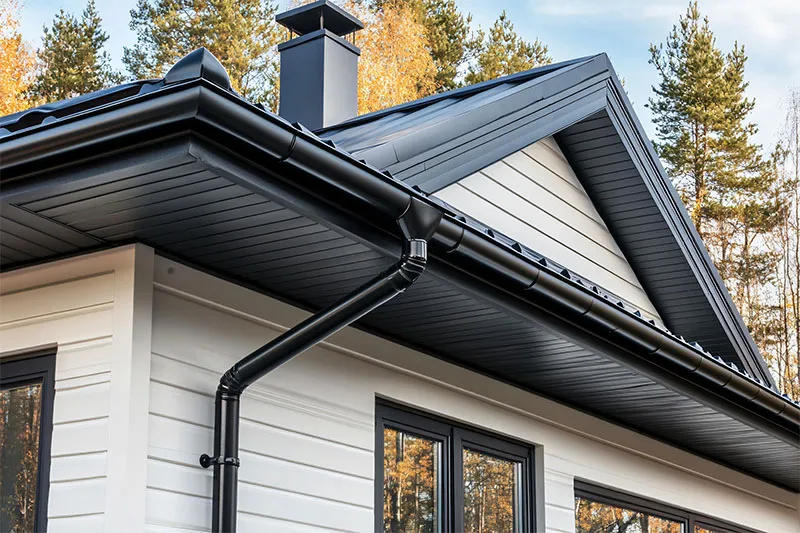
A University of Illinois guide advises setting gutters low enough that a straightedge laid along the roof clears the outer lip. Sliding snow and ice then pass over the gutter instead of tearing it loose.
Summer storms count too. NOAA Atlas 14 puts the 10-year, 5-minute rainfall intensity at Newton at about 6.3 inches per hour, so we size gutters and downspouts from the roof area. Compare seamless gutters and read 5-inch vs 6-inch gutters before you choose.
Windows
ENERGY STAR assigns Sussex to its Northern zone, which caps a certified window’s U-factor at 0.22. In EPA’s Version 7 analysis of vinyl windows, double-pane units with one low-E coating and argon typically rated 0.28 to 0.31. Triple-pane units with two low-E coatings reached 0.22 to 0.23. See triple-pane windows and our window replacement page.
Siding
Steel, vinyl and fiber cement are compared on our siding page. HomeGuide notes vinyl boards can crack where temperatures swing widely, which is worth weighing in a county this cold.
Towns we serve
Which Sussex County towns are in your service area?
Every one of the county’s 24 municipalities, from Vernon and Sparta to Montague and Sandyston on the Delaware River. The larger ones are:
- Vernon Township
- Sparta Township
- Hopatcong
- Wantage Township
- Newton, the county seat
- Hardyston Township
- Byram Township
- Andover Township
- Frankford Township
- Franklin
- Hampton Township
- Stillwater Township
- Montague Township
- Green Township
- Stanhope
- Hamburg
Listing a town means we serve it; it does not mean we have finished a job there. Across the county lines, Passaic and Morris counties are covered as well, and the service areas page lists all ten.
Permits
Is a permit needed to replace a roof in Newton, Vernon or Sparta?
No, as long as the house is detached and holds one or two families. Replacing its roof covering is ordinary maintenance under the state code.
The rule sits in N.J.A.C. 5:23-2.7 and also covers re-siding one- and two-family homes, except polypropylene siding, which needs a permit. Attached homes, such as townhouses and condominiums, generally need one for a new roof.
When a permit is needed, it comes from your municipality’s construction official. Skipping the permit never means skipping the membrane; we install it on every Sussex house roof.
Get a free estimate
Or call (732) 231-5327.
Sussex County roofing questions
Does Sussex County code require an ice and water membrane under a new roof?
Yes. NJ DCA Bulletin 07-3 identifies Sussex County as the part of New Jersey where the code’s ice barrier requirement applies, because the average daily January temperature is 25 degrees F or lower.
Does the ice barrier rule apply to my unheated barn or detached garage?
No. Bulletin 07-3 exempts detached accessory structures with no conditioned space. A heated or finished outbuilding does not qualify for that exemption, and we can add the membrane to any outbuilding on request.
What snow load should a Sussex County metal roof be designed for?
Start from 50 psf, the highest fallback NJ DCA Bulletin 19-1 gives any county, then check the address. The bulletin wants a site-specific value from an ASCE 7 hazard tool, and the fallback applies only to a case-study result.
Will snow slide off a metal roof onto my walkway?
It can, which is why we add snow guards over doors, walks, decks and parking spots. On standing seam they clamp to the seams, and their maker S-5! says the clamps attach without piercing the roof.
How big should gutters be on a Sussex County house?
It depends on roof area, pitch and downspout spacing. A University of Illinois guide says 5-inch gutters suit only roofs with downspouts under 30 feet apart, a pitch of 9:12 or less, and a drained roof area under 30 times the gutter length in feet; most other roofs call for 6-inch.
Sussex County estimates
Plan a Sussex County roof that meets the ice barrier code
Send us the address and what you need. We call back, set a time to measure, and spell out the membrane, panels, snow guards and gutters in a written estimate.
Or reach us by phone: (732) 231-5327