Metal roofing for central and north Jersey houses
Metal Roof Installation for New Jersey Homes
Metal roof installation in NJ starts with matching the right system to your house, its slope and the weather it sees each year. Our crews install standing seam, metal shingles with shake or slate looks, metal tile and corrugated panels on houses throughout the central and northern parts of the state. We also set up standing seam roofs to take solar later.
- 5 on Google (12 reviews)
- Lifetime workmanship warranty for as long as you own the home
- Free written estimates
The basics
What counts as a metal roof on a New Jersey house?
A residential metal roof is a steel or aluminum skin, painted or coated at the factory, fastened over fresh underlayment on your roof deck. In most cases it takes the place of an aging asphalt shingle roof.
Steel roofing panels are commonly Galvalume, a sheet coated with an aluminum and zinc alloy that slows corrosion. Aluminum usually costs more but cannot rust, which matters near salt water. Either metal can become long vertical panels or smaller pieces that copy shake, slate or clay tile.
Still weighing metal against asphalt? Our metal roof vs shingles comparison sets the two side by side.
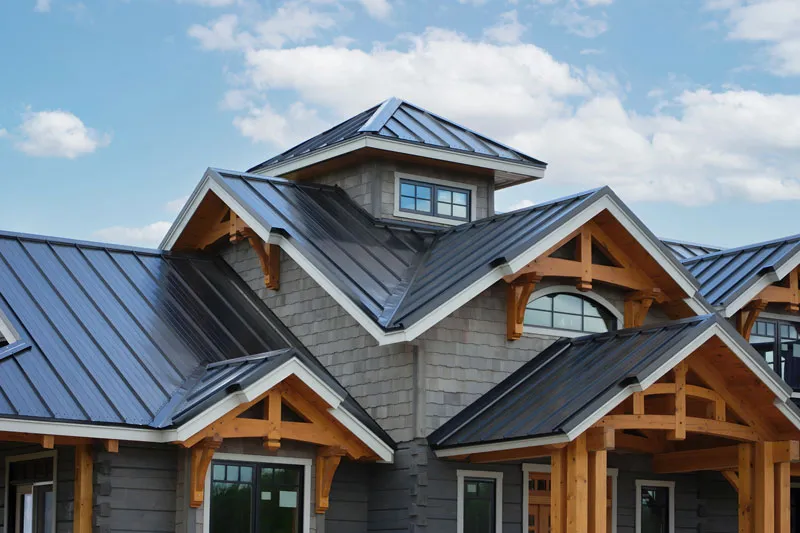
Our systems
Which metal roof types do we put on houses?
Each system has its own page. Standing seam is our main house roof; the others serve particular looks, outbuildings and solar plans.
Standing seam
Vertical panels interlock at tall ribs that hide the clips and screws. Our flagship roof for New Jersey houses. Standing seam metal roofs
Metal shingles and shakes
Steel, aluminum or stone-coated steel pieces that interlock and mimic shake, slate or shingle. A good fit for historic streets and HOA rules. Metal shingle and shake roofs
Metal tile
Panels pressed into a barrel or Spanish tile profile, much lighter than real clay or concrete. Metal tile roofs
Corrugated
Wavy screw-down panels for garages, sheds, barns and porch roofs on residential property. Corrugated metal roofing
Solar-ready
Standing seam laid out so solar mounts can clamp onto the ribs. We work alongside your solar company; we do not install the panels. Solar-ready metal roofs
Over existing shingles
Some roofs can take metal over the old layer, many cannot. Learn when a recover makes sense. Metal roof over shingles
Built for this climate
Why does metal suit New Jersey weather?
Metal copes well with this state’s snow, ice, wind and heat once the edges, clips, underlayment and snow guards are planned around them.
Heavy snow in the northern counties
New Jersey sets no single statewide snow load. DCA Bulletin 19-1 has designers pull ground snow figures lot by lot from hazard tools. Its fallback figures peak in the northwest: Sussex 50 psf, Passaic 40, Hunterdon and Morris 35, Somerset 30.
Smooth metal lets snow go quickly, so a row of snow guards over doors, decks and paths keeps it up there until it melts.
Ice dams at the eaves
Warm attic air thaws snow high on the roof; the meltwater runs down to the cold overhang and freezes into a ridge that holds back more water. That is how University of Minnesota Extension explains it. Metal clears snow faster, but insulation, air sealing and ventilation are what cut off the attic heat.
The state code makes an ice barrier mandatory only in places whose January average sits at 25 degrees F or below, and DCA Bulletin 07-3 names Sussex County as that area. We put a self-adhered eave membrane under every metal roof we install anyway, whatever the county. Our ice-dam guide covers the attic side.
Nor’easters and wind
Bulletin 19-1 also makes wind values site-specific, and clip and fastener spacing follows the panel maker’s tested instructions for those loads.
Summer heat and sun
Metal panels lengthen as the deck heats and shorten as it cools. Floating clips let long panels move without tearing at their fasteners. Paint matters too: MBCI, one panel maker, pitches its PVDF finish for stronger color retention and calls its SMP finish the budget choice.
Shore wind and salt air
Salt spray shortens the life of coated steel. Metal Sales writes its Galvalume warranty to exclude roofs closer than 1,500 feet to salt water, or roofs exposed to marine air or salt spray. Other makers draw the line at other distances, so we read the exact warranty for your address. Aluminum is the usual answer beside the ocean or a bay; our article on metal roofs at the Jersey Shore goes deeper.
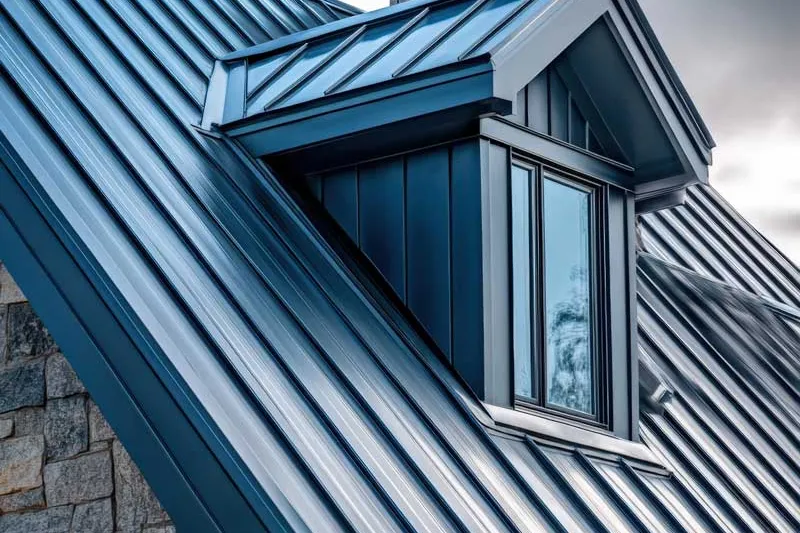
Choosing a system
How do you choose the right metal roof?
Start with three questions: how steep is the roof, what should it look like from the street, and how far is the house from salt water? Budget, solar plans and any HOA or historic rules narrow it from there.
| Your situation | Usually fits | Why |
|---|---|---|
| Main house roof, clean or farmhouse look | Standing seam | Hidden fasteners, single panels from eave to ridge, solar clamp ready |
| Low-slope porch or addition | Mechanically seamed standing seam | Some makers rate it for flatter roofs than snap-lock |
| Historic district or a strict HOA | Metal shingles or shakes | Reads like slate, shake or shingle from the street |
| Spanish or Mediterranean style house | Metal tile | Tile shapes on a light metal panel |
| Detached garage, shed, barn or porch | Corrugated | Simple screw-down panels suit outbuildings |
| Ocean, bay or marsh frontage | Aluminum, or a finish rated for the coast | Galvalume warranties often exclude salt-water zones |
| Solar panels planned | Solar-ready standing seam | Mounts clamp to the ribs instead of drilling the roof |
Slope rules some options out. The model residential code (2024 IRC text, sections R905.4 and R905.10) lets standing seam drop to a pitch of 1/4 inch per foot. Metal shingles need 3:12, and so do lapped screw-down panels unless the laps are sealed. Panel makers often ask for more slope, and their printed instructions control.
Gauge and finish
In standing seam, a 24 gauge sheet is thicker and stiffer than 26 gauge, and it costs more. PVDF paint usually carries a higher price than SMP because it keeps its color longer. The standing seam page explains both choices.
Historic districts and HOAs
Towns get the power to form historic preservation commissions from the state Municipal Land Use Law. Most local ordinances then send big exterior changes in a district through review, a New Jersey Historic Trust guide explains. Princeton’s Historic Preservation Commission, for instance, looks at applications across 21 overlay zoning districts. HOAs write their own rules on color and profile, so bring a copy to the estimate visit.
Cost overview
What do national guides say metal roofs cost?
Start with national figures. HomeGuide’s 2026 guide lists installed standing seam between $9 and $16 a square foot, and metal shingles between $6 and $14. For standing seam, HomeAdvisor (June 2026) reports a national average close to $19,000 and says most homeowners pay between $9,400 and $32,600.
Treat those as nationwide numbers, not New Jersey quotes. Size, pitch, layers to strip, valleys, chimneys, skylights, gauge and paint all push a price up or down, and we set yours after a free measurement.
We price every roof from a measurement at the house and put the total in writing.
On sales tax, New Jersey treats a full roof replacement as a capital improvement, so it is tax-free once the owner fills out Form ST-8 for the contractor (Division of Taxation bulletin S&U-3). Repairs stay taxable. Our New Jersey metal roof cost guide breaks the numbers down further.
How it works
From first call to finished roof in four steps
1
Call, text or send the form
Tell us what you need. Photos of the roof, gutters or siding help us come prepared.
2
Free visit and measurement
We measure the house, check the decking, flashing and drainage, and talk through systems and colors.
3
Written price and contract
You get the scope and the total price in writing. New Jersey law gives you three business days to cancel after you sign.
4
Install and walk-through
We install, clean up, walk the finished work with you and hand over the warranty paperwork.
Contract, permits and install
What happens before and during a metal roof installation?
Every metal roof installation in New Jersey starts with a written contract, then moves to tear-off and install. State law requires any home improvement contract above $500 to be written and signed by both sides (the state’s contractor law). The homeowner may also cancel for any reason up to midnight of business day three after receiving a copy.
On a freestanding one- or two-family house, the Uniform Construction Code treats a roof covering swap as ordinary maintenance, which needs no construction permit (the ordinary-maintenance rule). Townhouses and other attached homes generally need a permit; historic approvals are a separate track. See our guide to roof replacement permits in New Jersey.
- Protect the yard and plantings, then strip the old roof to bare deck.
- Check the decking; any repair outside the contract goes in a signed change order.
- Eave membrane along the edges, underlayment over the remaining deck.
- Flashing at walls, chimneys, valleys, skylights and pipes.
- Panels or shingles, then ridge, trim, vents and snow guards.
- Clean-up, a walk-around with you and the warranty documents.
Read more about how we run a job on our process page.
Warranty
Which warranties cover a metal roof?
Two kinds: our written workmanship warranty on the installation, and the manufacturers’ warranties on the metal and its paint.
Our workmanship warranty is a lifetime warranty: it covers our installation work for as long as you, the homeowner who signs the contract, own the home. It does not transfer to a later owner. Materials and paint finishes carry their manufacturers' own warranties, and the full written warranty comes with every estimate so you can read it before you sign.
Paint warranties reward a slow read. Sheffield Metals says PVDF paint often carries film adhesion coverage of 20 to 40 years but chalk-and-fade coverage of just 10 to 30, varying with color. Our warranty page explains what each warranty covers and how to make a claim.
Get a free estimate
Tell us about the house and the work. We visit, measure and give you a written price before any work starts.
Prefer to talk now? Call (732) 231-5327.
Your metal roof questions, answered
What lifespan can I expect from a metal roof here?
That rests on the metal, the paint and the workmanship. As one reference, Metal Sales warrants its Galvalume panels for 45 years against perforation under normal atmospheric conditions, minus exclusions such as salt-water zones. Read how long metal roofs last in New Jersey weather.
Is a construction permit needed for a metal roof?
Not on a freestanding one- or two-family house; the state code calls a roof covering swap there ordinary maintenance. Attached homes generally need a permit, and a historic district may want its own approval.
Is it possible to put metal over my current shingles?
Sometimes. That turns on how many layers the house already has, how sound the deck is, and what the code and the panel maker permit. See our page on metal roofs over shingles; at the visit we tell you which case applies.
Does a metal roof stop ice dams?
Not on its own. Ice dams begin with house heat leaking into the attic. Metal clears snow faster, and every metal roof we install gets an eave membrane, but insulation, air sealing and ventilation are the lasting fix.
Which metal makes sense for a house near the shore?
Read the panel warranty first. Metal Sales leaves roofs closer than 1,500 feet to salt water out of its Galvalume coverage, and other makers pick their own distances. Aluminum is the usual pick in those zones.
Can a metal roof carry solar panels?
Yes. Standing seam lets mounts clamp onto the ribs without drilling the panels. We build solar-ready roofs and work with your solar company, but we do not install the panels.
Which counties do you cover?
Ten counties: Middlesex, Somerset, Monmouth, Mercer, Morris, Hunterdon, Essex, Passaic, Ocean and Sussex. Our service areas page has a section for each county.
Free estimate
Ready for real numbers on your roof?
Describe the house for us. We visit, measure the roof and hand you a written price that spells out the system, gauge, paint and warranty.
Call (732) 231-5327 or send the form.