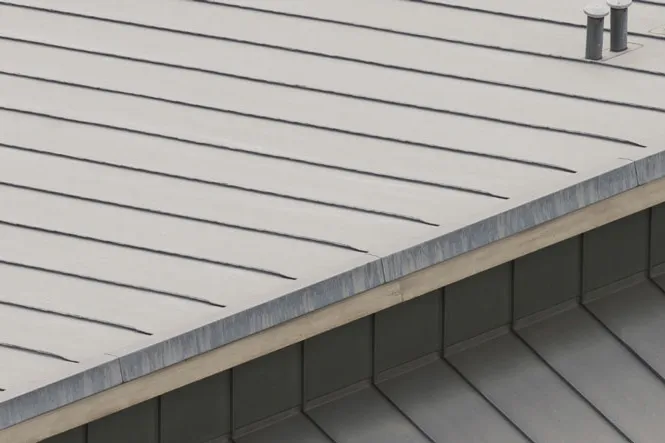
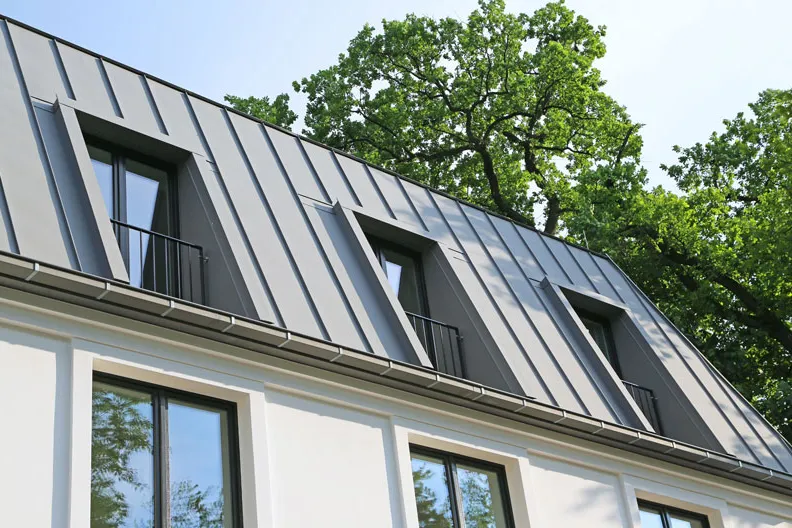
Choosing a metal roof at the Jersey Shore means planning for salt in the air and storms off the ocean, not only picking a color. Panel warranties often end at a set distance from the water, paint coverage has its own coastal fine print, and wind design is worked out for each address. A roof that suits a house a few miles inland may be the wrong pick in Sea Bright or on Long Beach Island.
This guide focuses on Monmouth and Ocean counties. None of it stands in for the written warranty on the panel you buy.
Where do Galvalume warranties stop near the water?
Each manufacturer draws its own line. Galvalume is sheet steel protected by a blend of aluminum and zinc, and its makers routinely write coastal limits into the paperwork. Two examples that are published:
- Metal Sales. The company’s Galvalume panel warranty promises 45 years without the steel rusting through, rupturing or failing structurally under ordinary weather. That promise ends 1,500 feet from salt water, and it also leaves out sites exposed to sea air or salt spray.
- Sheffield Metals. In a 2020 article on warranty types, Sheffield sums up the usual carve-outs in tiers: surf beaches within 1,500 feet, a large bay within 800, a marsh shoreline within 400, and any spot hit by steady spray, salt or fresh. It sends buyers back to each maker for the exact terms.
On a barrier island, few lots sit outside all of those rings. Houses on Barnegat Bay or Raritan Bay, along the back-bay marshes, or beside tidal rivers like the Navesink and Shrewsbury need the same check. Whether brackish water triggers an exclusion is each manufacturer’s call, so get the answer on paper.
Before comparing quotes, measure on a map from your house to the closest salt water, and ask every contractor which panel’s warranty reaches that far. If no Galvalume product covers your lot, move to aluminum or to a coating its maker warrants for marine air, and get that coverage written down as well.
| Source | What it says about the coast | Coverage it applies to |
|---|---|---|
| Metal Sales Galvalume warranty | Void closer than 1,500 feet to salt water, or where sea air or salt spray reaches | Galvalume panels rusting through, for 45 years |
| Sheffield Metals | Usual limits: surf 1,500 feet, large bay 800 feet, marsh 400 feet, steady spray | Galvalume base-metal warranties in general |
| MBCI | Paint coverage can change on the coast; a coating made for sea air is offered | Painted panel finishes |
| Quality Edge TruCedar | Excluded under 1,500 feet from salt water or where salt spray reaches | Steel siding |
Manufacturers revise these documents, so use the table to frame your questions and then read the current version for your product. Our warranty page explains where a maker’s coverage ends and our written workmanship warranty begins.
When does aluminum make more sense than steel?
When the house sits inside the zone where Galvalume coverage stops. Aluminum has no iron in it, so it cannot rust the way steel does, which is why it comes up as the alternative right by the water.
It is light, too. Classic Metal Roofing Systems puts aluminum roofing at 40 to 70 pounds for each 100 square feet. Its figures for steel run 80 to 125 pounds, and for fiberglass-asphalt shingles 275 to 425. A metal roofing company published those numbers, but the spread is hard to miss.
Switching to aluminum does not settle everything. The paint, the trim, the screws and clips, and a written warranty that names your location all still matter. Our standing seam page sets Galvalume and aluminum side by side, along with gauges and seam types.
What should a paint warranty say near the beach?
It should name the coastal terms for your site, not just the standard inland ones. MBCI warns that its paint coverage can change in punishing settings, the coast among them, and it sells a coating designed for sea air and spray.
Resin is the other variable. MBCI’s top line, Signature 300, uses a 70 percent PVDF resin to hold its color, while its budget line, Signature 200, uses silicone-modified polyester (SMP). The company gives both 30 years on colorfastness and 40 on film integrity, and says coastal jobs may see different terms.
Sheffield Metals puts typical PVDF chalk-and-fade terms anywhere from 10 to 30 years, with the color making the difference. It also notes that a big SMP warranty figure usually refers to the film staying bonded, while fading gets less time. So ask how long your chosen color is covered for chalking and fading at your distance from the water.
What about fasteners, clips and trim?
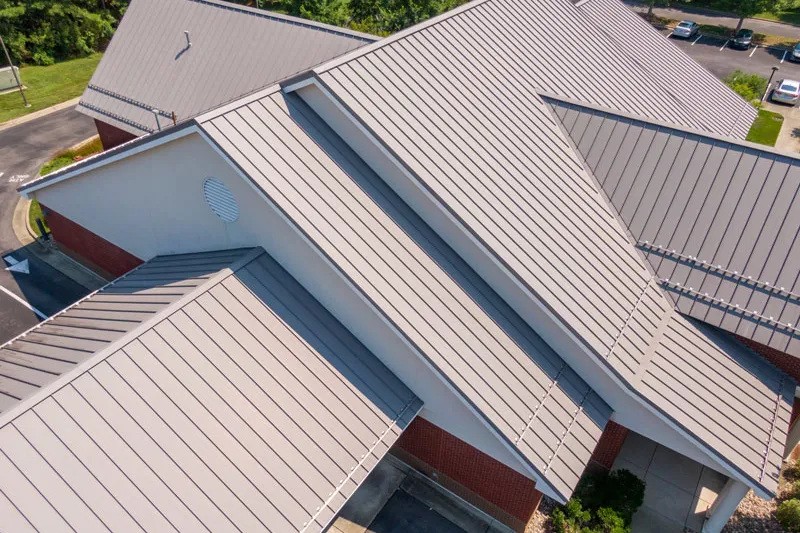
Hidden attachment leaves less hardware out in the salt air than exposed screws do. With standing seam, clips tucked under each seam do the holding, so there are no screw heads sitting on the face of the roof.
Exposed-fastener panels take screws straight through the face. Sheffield Metals points out that UV light wears out the rubber washers under those heads before the panels age. It advises a fastener check every year, or twice a year, swapping out any screw that is loose, backing out, rusting or worn.
Put the same questions to each contractor you talk to. What are the clips, screws and trim made of? Does the panel maker’s coastal coverage extend to them? How will the flashing be sealed where the roof meets walls and chimneys?
Keep copper and Galvalume apart as well. Metal Sales also voids coverage where water drains onto the panels from copper or lead, or where copper, lead or graphite touches them. If a shore house is getting copper half-round gutters, choose the roof metal and the drainage layout with that in mind.
How are wind loads set for a shore roof?
By the address. There is no statewide figure to look up. Under DCA Bulletin 19-1, a designer enters the specific property into an online hazard tool built on the ASCE 7 standard and reads the value for that spot. The bulletin names ATC Hazards by Location and the ASCE 7 Hazard Tool.
Plugging in a town center or a ZIP code instead could understate the number, the bulletin cautions, and elevation can shift it. That means two houses in one shore town may not share a value.
For you, the useful move is a pair of questions. Which wind value did the contractor pull for your address, and from which tool? How does the clip or fastener spacing they plan satisfy it under the panel maker’s installation instructions? A solid answer names the tool, the number and the attachment pattern.
What did Superstorm Sandy show about shore roofs?
That wind and water hit together here. The Weather Service office in Mount Holly records Sandy’s landfall near Brigantine around 7:30 in the evening on October 29, 2012, by then classed as a post-tropical cyclone.
At Sandy Hook, the surge had lifted water 8.9 feet over ground level by the time the tide gauge quit. Near Mantoloking, the ocean opened two new inlets across the barrier island.
The storm also reshaped New Jersey’s permit rules. In 2013 minutes, the state’s Construction Advisory Board noted that roofing and siding permits had been suspended after Sandy. A later rule change wrote that exemption into the code for freestanding one- and two-family houses.
Sandy was the extreme, not the only risk. The state climatologist’s office at Rutgers says nor’easters cluster between October and April, and that a significant coastal storm turns up almost every winter. When one of them, or a tropical storm, arrives at high tide, the damage can be severe.
What should Monmouth and Ocean county homeowners check?
Start with the distance to salt water, then fit the metal, the finish and the fasteners to it. Both counties are in the state’s 4A energy climate zone.
- Measure from the house to the ocean, the bay, a tidal river or marsh, and keep that number with your quotes.
- Get the metal warranty and the finish warranty in writing, with any coastal exclusion spelled out.
- Ask whether aluminum or a marine-rated coating is in the proposal, and why.
- Ask what the clips, screws and trim are made of.
- Ask which wind value was used for your address and where it came from.
- Confirm the permit question. A freestanding house built for one or two families is usually ordinary maintenance; attached and multifamily buildings generally are not.
- Plan the gutters for cloudbursts. NOAA Atlas 14 estimates about 6.7 inches an hour for a 10-year, 5-minute burst at Toms River.
Local housing and permit notes are on our Monmouth County and Ocean County pages. Our roof permit guide covers the permit rule in depth, and 5-inch vs 6-inch gutters covers gutter sizing.
Salt reaches the walls as well. Quality Edge’s TruCedar coverage leaves out steel siding less than 1,500 feet from salt water or exposed to salt spray, so the same map measurement applies to steel siding.
Coastal choices move the price. HomeGuide’s national metal roof guide puts installed standing seam between $9 and $16 for each square foot. We found no published figure specific to the shore, and your exact price comes from a free measurement.
Get a free estimate
Or call (732) 231-5327.
Jersey Shore metal roof questions
What distance from salt water voids a Galvalume roof warranty?
That depends on who made the panel. Metal Sales drops coverage on its Galvalume panels less than 1,500 feet from salt water, or wherever sea air or spray reaches. Sheffield Metals describes the usual tiers as surf within 1,500 feet, a large bay within 800 and a marsh within 400. Read the warranty for your exact panel.
Do bays and salt marshes trigger the same warranty limits as the ocean?
Often they do, at shorter range. Sheffield Metals cites a large bay at 800 feet and a marsh at 400 as common Galvalume limits. If you live on Barnegat Bay, Raritan Bay or a back-bay marsh, get the coastal terms in writing.
Is there a set wind rating for shore roofs in New Jersey?
No. DCA Bulletin 19-1 has designers pull a wind value for the specific address from an ASCE 7 hazard tool, and warns that a ZIP code center could understate it. Ask your contractor which value and tool they used.
Should a house near the ocean get aluminum panels instead of steel?
Often, if Galvalume coverage stops short of your lot. Aluminum cannot rust the way steel does, but its paint and fasteners still need coastal coverage in writing, so compare the warranties that apply to your address rather than the metal alone.
Does re-roofing a shore house with metal require a construction permit?
Usually not for a freestanding house built for one or two families, which N.J.A.C. 5:23-2.7 treats as ordinary maintenance. Townhouses and multifamily buildings generally need one, and some towns add their own historic review.
Sources
- Metal Sales, Galvalume panel warranty form (12-23)
- Sheffield Metals Learning Center: roof and wall warranty review (2020), roof upkeep article (2022)
- MBCI, article on its paint systems
- Quality Edge, TruCedar siding warranty page
- Classic Metal Roofing Systems, roof weight comparison
- NJ Department of Community Affairs: design load bulletin 19-1, advisory board minutes
- N.J.A.C. 5:23-2.7 on ordinary maintenance, via Cornell’s legal information site
- NWS Mount Holly, Sandy retrospective
- Rutgers, state climate overview
- NOAA rainfall frequency server; HomeGuide metal roof price guide
Building near the water
Get a shore roof priced for your exact address
We measure the roof, note how far the house sits from salt water and show you which panel and finish terms apply before you sign.