Fiber cement siding for central and northern New Jersey
Fiber Cement Siding for New Jersey Homes
Fiber cement siding in NJ gives a house the lines of painted wood clapboard on a heavy, rigid board with a long manufacturer warranty. The choices that matter most are the finish, the warranty behind it and the details that keep water out of the wall.
- 5 on Google (12 reviews)
- Lifetime workmanship warranty for as long as you own the home
- Free written estimates
The basics
What is fiber cement siding?
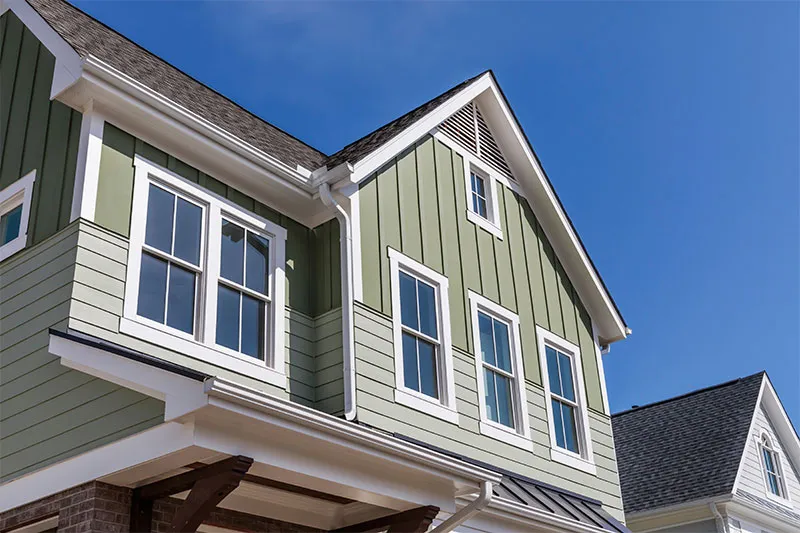
Fiber cement is a cement-based board reinforced with fibers and made in lap, shingle and trim shapes. It goes up board by board, much like wood clapboard, and it is painted either at the factory or on the house.
HomeGuide’s national guide estimates a 50 to 75 year life for fiber cement, the longest of the three sidings we install. That figure is for the board. The paint on top is a separate question, and it is where the real choice sits.
Finish
Factory finish or field paint?
Both work. The difference is who applies the color, when, and which warranty covers it. Factory-finished boards arrive painted; primed boards are painted on the house after they go up.
| Factory finish | Primed, painted on site | |
|---|---|---|
| Who applies the color | The board maker, before delivery | A painter, after the boards are installed |
| Color choice | The maker’s color list | Any exterior paint color you choose |
| Finish warranty | James Hardie: 15-year limited warranty on ColorPlus, covering paint and labor against peeling, cracking and chipping | The paint maker’s terms for the paint; the board warranty stays separate |
| Timing | No painting step after the install | Painting adds a step and depends on the weather |
| Small touch-ups | Follow the board maker’s instructions | Use the same paint as the walls |
James Hardie says its primed, non-ColorPlus siding must be field-painted with an acrylic topcoat. Neither its FAQ nor its blog gives a repaint interval for either option, so treat any repaint promise with care. The fair way to describe the factory option is that its finish is warranted for 15 years, not that it never needs paint.
Warranties
What do fiber cement warranties actually cover?
Two separate things: the board and the finish. James Hardie, whose terms are published, gives a 30-year limited warranty on its fiber cement board and a separate 15-year limited warranty on its ColorPlus factory finish.
The finish warranty covers paint and labor against peeling, cracking and chipping. Fade resistance is marketed, but fading is not listed as covered, and the company’s blog calls the finish warranty prorated, meaning coverage shrinks as the years pass. The board warranty does not cover the paint.
We name James Hardie only because its terms are public and clear. Your estimate names the product we propose, and that product’s warranty is the one to read. Separately, we give a written workmanship warranty on our installation; the warranty page explains how the pieces fit together.
Our workmanship warranty is a lifetime warranty: it covers our installation work for as long as you, the homeowner who signs the contract, own the home. It does not transfer to a later owner. Materials and paint finishes carry their manufacturers' own warranties, and the full written warranty comes with every estimate so you can read it before you sign.
Installation
Why do weight and installation details matter?
Fiber cement is heavier and stiffer than vinyl, so it is carried, cut and fastened differently, and the maker’s printed instructions control almost every detail. We install to those instructions on every job.
- Long boards need careful handling so they do not crack before they reach the wall.
- Cutting makes fine dust, so cuts are made with dust control and away from open windows.
- Nailing follows the maker’s fastener type, spacing and placement.
- Clearances above the ground, roofs, decks and walkways follow the printed numbers for the product.
- Cut edges and nail heads are treated the way the maker specifies.
Moisture
How do you keep water out of a fiber cement wall?
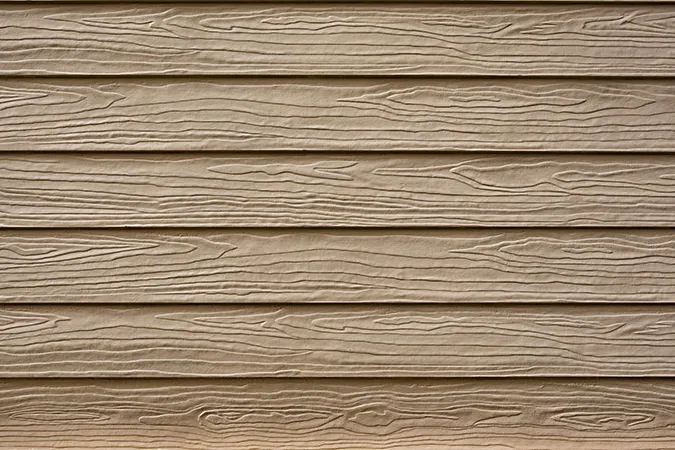
Treat the board as the outer layer of a drainage system, not as the waterproofing. Behind it sits a weather barrier, with flashing at every window, door and roof-to-wall joint to send water back out.
That matters in New Jersey, where average yearly precipitation runs from about 40 inches on the southeast coast to about 51 inches in north-central counties, per the State Climatologist. Coastal storms, most frequent from October to April, can drive that rain hard against the walls.
The details we watch most on fiber cement:
- Clearance between the bottom course and the ground, mulch, roofs and decks, as the maker prints it
- Flashing above windows and doors, and kick-out flashing where a roof edge meets a wall
- Joints and gaps handled the way the instructions call for, with sealant only where specified
- Gutters that carry roof water away instead of dumping it down the wall
Gutters are part of the wall’s defense. If yours are tired, replace them with the siding; see gutter installation and soffit and fascia.
Budget
What does fiber cement siding cost?
National guides put fiber cement in the middle of the siding price range. HomeGuide estimates $6 to $15 per square foot installed, against $4 to $12 for vinyl and $7 to $16 for steel, plus $0.70 to $2.00 per square foot to remove old siding.
Factory finish or field paint, trim boards, the number of stories, rot repairs and lead-safe removal all move the number. These are national estimates, not New Jersey prices. New siding is an exempt capital improvement for New Jersey sales tax when you give the contractor Form ST-8, per the NJ Division of Taxation. Your exact price comes from a free measurement.
Older homes
Is fiber cement a good fit for an older house?
It often is, because it can echo painted wood clapboard. The prep is the hard part. In a house built before 1978, EPA’s RRP rule covers paid work that disturbs more than 20 square feet of painted surface outside, so taking off old siding or painted trim calls for lead-safe work practices.
New Jersey’s Rehabilitation Subcode also bars uncontained power washing and dry scraping of 10 square feet or more per building outside on those surfaces, unless the paint tests lead-free. Permits are simpler: the state code counts new siding on a detached one- or two-family house as ordinary maintenance, though historic districts can require their own review.
Our siding overview covers both topics. Compare vinyl siding and seamless steel siding, or read our guide to vinyl, fiber cement and steel. We install fiber cement in ten counties; see our service areas. Planning a roof too? Our metal roofing pages cover it.
Get a free estimate
Tell us about the house and the work. We visit, measure and give you a written price before any work starts.
Prefer to talk now? Call (732) 231-5327.
Fiber cement siding questions
Does fiber cement siding have to be painted?
Primed boards do. James Hardie says its primed, non-ColorPlus siding must be field-painted with an acrylic topcoat. Factory-finished boards arrive painted, and that finish carries its own 15-year limited warranty.
What do fiber cement warranties cover?
Taking James Hardie as the published example: a 30-year limited warranty on the board, and a separate 15-year limited warranty on the ColorPlus finish covering paint and labor against peeling, cracking and chipping. Fading is not on that list, and the company’s blog calls the finish warranty prorated.
Is fiber cement heavier than vinyl?
Yes. Fiber cement boards are heavier and stiffer than vinyl panels, so they are carried, cut and fastened differently. We install them to the maker’s printed instructions for fasteners, spacing and clearances.
How does fiber cement handle moisture?
The board is cement-based, but water still has to be managed around it. A weather barrier behind the boards, flashing at openings and roof-to-wall joints, clearances above the ground and roofs, and the maker’s rules for cut edges all keep the wall dry.
How much does fiber cement siding cost compared with vinyl?
HomeGuide’s national guide estimates $6 to $15 per square foot installed for fiber cement and $4 to $12 for vinyl. Those are national figures, not New Jersey prices; your exact price comes from a free measurement.
How long does fiber cement siding last?
HomeGuide estimates 50 to 75 years, the longest of the three sidings we install. The finish on top is warranted for a much shorter period, so plan for it separately.
Free estimate
Want a price on fiber cement siding?
We measure the house, talk through factory finish versus field paint, and put the product, finish and trim in a written estimate.
Call (732) 231-5327 or send the form.