Soffit, fascia and attic venting
Soffit and Fascia Repair for New Jersey Homes
Soffit and fascia work in NJ handles two jobs at the edge of your roof: letting the attic draw in fresh air, and giving your gutters solid wood to hang on. We find the rot, replace the wood, open up the soffit venting and cap the fascia in aluminum.
- 5 on Google (12 reviews)
- Lifetime workmanship warranty for as long as you own the home
- Free written estimates
The roof edge
What do soffit and fascia do?
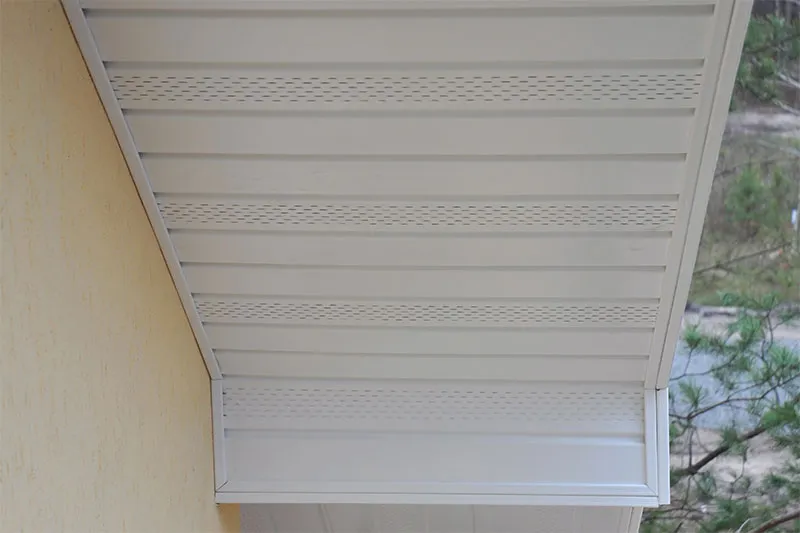
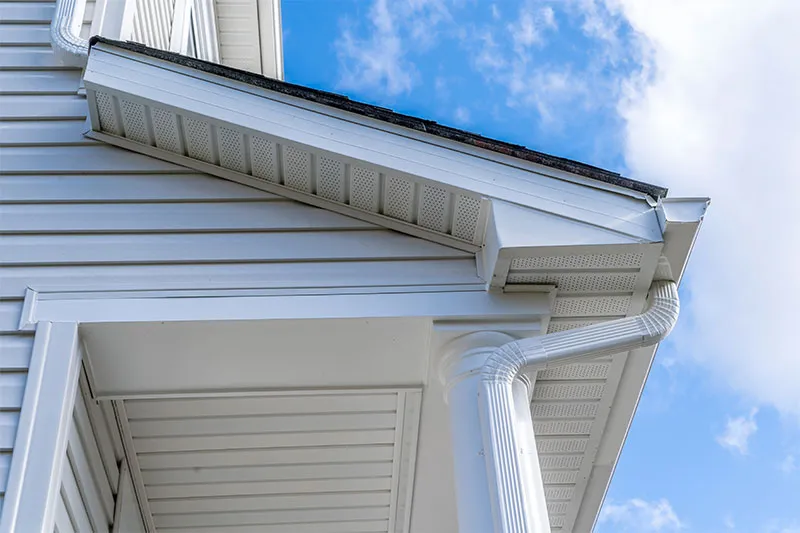
Soffit is the finished ceiling under the roof overhang. Fascia is the board along the ends of the rafters, between the roofing and the soffit, and it is usually where the gutters hang.
Soffit
The soffit covers the overhang, or eave, from the wall out to the fascia. When it is vented, it becomes the attic’s fresh-air intake. As warm air leaves high on the roof through a ridge or gable vent, cooler outside air is drawn in at the eaves, as Ply Gem explains.
Fascia
The fascia is attached to the rafter ends, as Kaycan’s siding glossary defines it, and it carries every gutter hanger. Because it sits right behind the gutter, it is often the first wood on the house to rot when a gutter overflows or leaks.
Attic ventilation
How much soffit venting does an attic need?
Under the model residential code, an attic needs net free vent area of at least 1/150 of its floor area. That drops to 1/300 when 40 to 50 percent of the vent area sits high, within 3 feet of the ridge, and the rest sits low in the attic, which is where soffit vents go.
Those ratios are in Section R806 of the 2024 International Residential Code, which New Jersey adopted with state amendments effective August 17, 2026. The section also asks for at least a 1-inch air space between insulation and roof sheathing at soffit vents. Its extra vapor-retarder condition applies only in climate zones 6 to 8, and New Jersey is in 4A and 5A.
| Attic floor area | Net free vent area at 1/150 | At 1/300, balanced high and low |
|---|---|---|
| 1,000 sq ft | About 6.7 sq ft | About 3.3 sq ft |
| 1,500 sq ft | 10 sq ft | 5 sq ft |
| 2,000 sq ft | About 13.3 sq ft | About 6.7 sq ft |
Balance matters as much as the total. Soffit intake and ridge exhaust work as a pair, and either one alone works poorly. When we price soffit work we look at the exhaust side too. A new ridge vent is roof work, usually done with a re-roof; see our roofing and metal roofing pages.
Ice dams
Will vented soffit stop ice dams?
Not by itself. The Department of Energy’s Building America Solution Center names three defenses that work together: air-seal the ceiling, insulate the attic well, and ventilate the roof from vented soffits to a continuous ridge vent.
Ice dams form when the roof deck under the snow warms above freezing, usually from house heat leaking into the attic. Meltwater runs down to the cold eave and refreezes there. DOE’s guidance calls for vented soffit in every rafter bay, with baffles so insulation does not block the vents.
Building Science Corporation adds that ventilation should supplement good insulation, not stand in for it, and recommends at least R-30 below a ventilated attic roof. Very low insulation cannot practically be offset by venting, so more soffit vents alone will not cure ice dams in a thinly insulated attic.
For the causes and the fixes in more depth, see our ice-dam guide.
Rot repair
How is rotted fascia repaired?
The soft wood comes out and new wood goes in before anything covers it. HomeGuide’s soffit and fascia guide says to fix rotted fascia first, before capping it or hanging new gutters on it.
Signs to look for: peeling paint along the board, wood that gives under a screwdriver, sagging gutters, stains on the soffit, or gaps where birds or squirrels get in.
How we handle it:
- Take down the gutter on that run, to rehang it or replace it with a new seamless gutter
- Cut out the rotted fascia and soffit and check the rafter tails behind them
- Show you any rotted rafter tails and price that repair in writing before we fix it
- Replace the damaged wood, install vented soffit where the attic needs intake, and cap the fascia
- Rehang the gutter on sound wood, sloped toward the downspouts
Every gutter hanger screws into the fascia, so the wood has to hold. A University of Illinois guide spaces hangers for aluminum gutters at 32 inches or less, tightening to 16 to 24 inches in places where snow and ice linger through the winter. See seamless gutters for sizing.
Aluminum capping
What is aluminum fascia capping?
Capping wraps the wood fascia in painted aluminum bent to fit on site. The wood stays in place underneath, but rain and sun hit the metal instead of the paint.
The material is aluminum trim coil. One maker, CertainTeed, sells 0.019-inch coil for wrapping fascia boards and the casings around windows and doors, with a painted finish it says will not rot or rust and a 10-year limited warranty. Quality Edge lists pre-formed aluminum fascia at 0.019 to 0.024 inch and soffit at 0.016 to 0.019 inch.
Capping only works over sound wood; wrapping a rotted board hides the rot and traps moisture, so we repair first and cap second. The same coil caps window casings, so this work often pairs with window replacement.
InterNACHI, the home inspectors’ association, puts aluminum soffit and fascia at 20 to more than 40 years, assuming regular upkeep. That is a guideline, not a promise. Our written workmanship warranty is separate from the coil maker’s finish warranty; see our warranty page.
Our workmanship warranty is a lifetime warranty: it covers our installation work for as long as you, the homeowner who signs the contract, own the home. It does not transfer to a later owner. Materials and paint finishes carry their manufacturers' own warranties, and the full written warranty comes with every estimate so you can read it before you sign.
Older homes
How is soffit and fascia work done lead-safe on a pre-1978 house?
If the house predates 1978, cutting out old fascia, pulling soffit or scraping painted trim usually counts as lead-paint work. EPA treats only small exterior jobs, 20 square feet of disturbed paint or less, as minor repair, and a whole-house eave job typically goes past that.
For covered work under EPA’s Renovation, Repair and Painting rule, the firm must hold EPA certification and its certified renovators must follow lead-safe practices. EPA runs the program in New Jersey, where about 61 percent of homes predate 1980 according to the Census Bureau’s 2024 American Community Survey.
Unless a test shows the paint is lead-free, the state’s Rehabilitation Subcode (N.J.A.C. 5:23-6.4) rules out several prep methods on pre-1978 exterior paint. Open-flame burning is out, as are heat guns hotter than 1,100 degrees F and power washing without containment. So is dry scraping or sanding across 10 or more square feet of the building, and power sanders must have a HEPA vacuum attached.
Those limits shape how old trim is prepared before capping. Ask to see the firm’s EPA certificate before anyone starts scraping.
Budget
What does soffit and fascia replacement cost?
HomeGuide’s national guide puts soffit and fascia replacement together at about $9 to $34 per linear foot. That is roughly $900 to $6,800 for the 100 to 200 linear feet on a typical home, and repairs run about $500 to $2,600.
- Fascia board replacement: $5 to $12 per linear foot, including taking down and rehanging the gutters
- Soffit: $4 to $22 per linear foot
- Continuous soffit vent: $2.50 to $4.00 more per linear foot; single vents $15 to $30 each
- Material only: aluminum fascia $1.25 to $4.00 and aluminum soffit $2.00 to $3.50 per linear foot
What moves the number: how much wood is rotted, eave height, whether the gutters are rehung or replaced, and lead-safe setup. These are national estimates (HomeGuide, Nov. 7, 2025), not New Jersey prices. Your exact price comes from a free measurement.
Any home improvement job over $500 in New Jersey must be in writing and signed by you and the contractor. State law (N.J.S.A. 56:8-151) also lets you cancel for any reason before midnight of the third business day after you get your copy. Our process page walks through ours.
Plan it together
Should soffit and fascia be done with gutters, siding or a roof?
Often, yes. The fascia carries the gutters, the soffit meets the siding, and the eave is where a new roof finishes, so one visit can cover all three.
If the gutters are coming down anyway, it is a good time for new seamless gutters sized to the roof; see all our gutter options. Re-siding? Plan the soffit and trim with the new siding. Replacing the roof? Ask how the ridge vent and the soffit intake will be balanced.
We do soffit and fascia work in ten New Jersey counties, from Sussex and Passaic down to Mercer and Ocean. Our service areas page lists them all.
Get a free estimate
Or call (732) 231-5327.
Soffit and fascia questions
What is the difference between soffit and fascia?
Soffit is the material under the roof overhang, between the wall and the roof edge. Fascia is the board across the ends of the rafters, facing out, where the gutters usually hang. Vented soffit is also where the attic draws in outside air.
How much attic ventilation does my house need?
The model residential code asks for net free vent area of 1/150 of the attic floor area, or 1/300 when 40 to 50 percent of it is high near the ridge and the rest is low at the eaves. A 1,500-square-foot attic needs 10 or 5 square feet.
Can you put aluminum over rotted fascia?
It should not be done. Capping over rot hides it and holds moisture against the wood, and HomeGuide likewise says to fix rot before any capping or gutter work. We replace the soft wood first, then cap.
Will more soffit vents stop ice dams?
Not on their own. DOE says the defenses are air sealing the ceiling, insulating the attic and venting the roof together, and Building Science Corporation calls ventilation a supplement to good insulation. Vents help keep the roof deck cold; they do not replace insulation.
How much does soffit and fascia repair cost?
HomeGuide’s national guide lists soffit and fascia repairs at about $500 to $2,600, and full replacement of both at about $9 to $34 per linear foot. None of the sources we use publishes a New Jersey figure. Your exact price comes from a free measurement.
Is lead paint a concern when replacing old fascia?
Very likely, if the house dates from before 1978. A full eave job typically disturbs more exterior paint than the 20 square feet EPA’s RRP rule exempts as minor repair. New Jersey’s code separately rules out dry scraping across 10 or more square feet outside, and uncontained power washing, unless the paint tests lead-free.
Free estimate
Get your roof edge checked and priced
We look at the fascia, the soffit, the gutters and the attic venting, then put the repairs, materials and vent plan into a written estimate.
Phone (732) 231-5327, or use the form on this page.