Ice dam prevention in NJ starts in the attic, not on the roof. An ice dam grows when warmth from the living space softens the snow near the ridge and the runoff freezes again at the colder edge. The fixes that last are sealing air leaks, adding insulation and venting the roof, with a waterproof eave membrane as the backstop.
What causes an ice dam?
Uneven roof temperature. University of Minnesota Extension lays out the cycle. Warmth leaking out of the living space heats the high part of the roof, and the snow over it turns to water. That water trickles toward the eave, which stays cold, and freezes there into a ridge. Later runoff pools behind the ridge, works back under the roofing and can leak into the attic, walls or ceilings.
The U.S. Department of Energy’s Building America Solution Center puts the trigger simply: a roof deck that warms past freezing beneath the snow. The extension’s own summary is that nonuniform roof surface temperatures lead to ice dams. Keep the deck evenly cold and the cycle loses its usual starting point.
Signs you have one
- A thick ridge of ice along the gutter line, often with heavy icicles below it.
- Stains or drips on ceilings or walls near outside walls, especially during a thaw.
- Bare or melted stripes on the upper roof while the lower roof stays snow-covered.
- Gutters packed with ice, or gutters pulling away from the fascia.
What is the right order of fixes for ice dam prevention in NJ?
Seal air leaks first, then insulate, then ventilate. That is the order of the Building America Solution Center’s three defenses: fully air-seal the ceiling, thoroughly insulate the attic and ventilate the roof.
Building Science Corporation backs that order in its BSD-135 digest. It treats venting as a helper to good insulation, and says no practical amount of venting makes up for very thin insulation.
1. Seal the air leaks into the attic
Warm house air slips into the attic through gaps in the top-floor ceiling. Building Science Corporation names the usual openings:
- plumbing vent stacks
- recessed lights
- gaps around chimneys
- wiring penetrations
- attic hatches
Sealing these is attic work, not roof work. We are roofers, not insulation contractors, so we point out what we see at the estimate visit and you can have it sealed before or alongside a new roof.
2. Insulate the attic floor
Insulation slows the heat that gets past the ceiling. The BSC digest sets R-30 as the floor for insulation beneath a vented attic roof.
New Jersey’s energy code places Sussex, Passaic, Morris, Hunterdon and Somerset in zone 5A, with our other five counties in 4A, per DCA Bulletin 22-1. The northern 5A counties also get the most snow.
Your utility may help pay. According to the NJ Clean Energy Program, the utilities run a Whole Home Energy Solutions program centered on insulation and air sealing, done by contractors holding BPI certification. Moderate-income customers can also get no-cost weatherization. The federal 25C credit that once covered insulation does not apply to anything put into service after 2025, per the IRS.
3. Ventilate from soffit to ridge
Ventilation carries off the heat that still gets through and helps keep the deck cold. The Building America guidance pulls outside air in through vented soffits at every rafter bay and lets it out at a continuous ridge vent. Baffles keep the insulation from blocking the soffit vents.
The model residential code, in its Section R806, sets a ratio of net free ventilating area to attic floor of at least 1:150. The ratio relaxes to 1:300 if 40 to 50 percent of the venting is up high, no more than 3 feet below the ridge, and the remainder is low. It also wants a gap of an inch or more between the insulation and the roof sheathing where the eave vents are.
For a 1,500-square-foot attic floor, that means 10 square feet of net free area at 1:150, or 5 square feet at 1:300. Soffit vents blocked by insulation or paint cannot take in air, so soffit work is often part of the fix. Vented soffit and rotted fascia are covered on our soffit and fascia page.
Is an eave membrane required by New Jersey code?
Only in Sussex County. Code language ties the ice barrier under the roofing to places where January’s mean daily temperature is no warmer than 25 degrees F. DCA Bulletin 07-3 says that describes Sussex County, so in the rest of the state the membrane is optional under code.
We put an eave membrane on every roof we install, in all ten of our counties. The Building America Solution Center calls self-adhering membranes standard practice in ice-dam-prone areas. A membrane does not stop an ice dam from forming. It is there to keep water that backs up behind one off the deck while the attic gets fixed.
How much snow do different parts of New Jersey get?
Snow totals drop sharply from north to south. The Office of the New Jersey State Climatologist at Rutgers reports 40 to 50 inches of snow a year on average in the northern zone, Sussex, Passaic and Morris among it. The far south gets 10 to 15.
Design snow loads follow the same pattern. DCA’s Bulletin 19-1 sends designers to an online ASCE 7 hazard lookup for each property’s ground snow load. If the lookup labels the property a case study rather than returning a number, the state accepts the fallback figures shown here.
| County | Energy climate zone | In the climatologist’s northern snow zone? | Fallback ground snow load (Bulletin 19-1) | Ice barrier required by code? |
|---|---|---|---|---|
| Sussex | 5A | Yes | 50 psf | Yes |
| Passaic | 5A | Yes | 40 psf | No |
| Morris | 5A | Yes | 35 psf | No |
| Hunterdon | 5A | No | 35 psf | No |
| Somerset | 5A | No | 30 psf | No |
| Essex, Mercer, Middlesex, Monmouth, Ocean | 4A | No | Site-specific value from the hazard tool | No |
The north also holds the state’s 48-hour snowfall record: 34.0 inches at Oak Ridge Reservoir on December 26-27, 1947, confirmed in 2026 by the national State Climate Extremes Committee.
Do gutters cause ice dams?
No. The dam forms at the roof edge from meltwater that refreezes, and gutters fill with ice as a result. A frozen gutter adds weight at the eave, which is why winter hanging matters.
A University of Illinois building guide wants aluminum gutter hangers 32 inches apart or less, tightened to 16 to 24 inches where snow and ice hang around for much of the season. It also suggests hanging the gutter low enough that a board laid along the roof slope would pass over its front lip, so a sheet of sliding snow cannot rip it down. We hang our seamless gutters with those winter loads in mind.
Guards are a separate choice. This Old House advises against reverse-curve guards where snow and ice accumulate, and in its tests every guard type still needed some upkeep. Our gutter guard page compares the types.
What does a metal roof change about snow and ice?
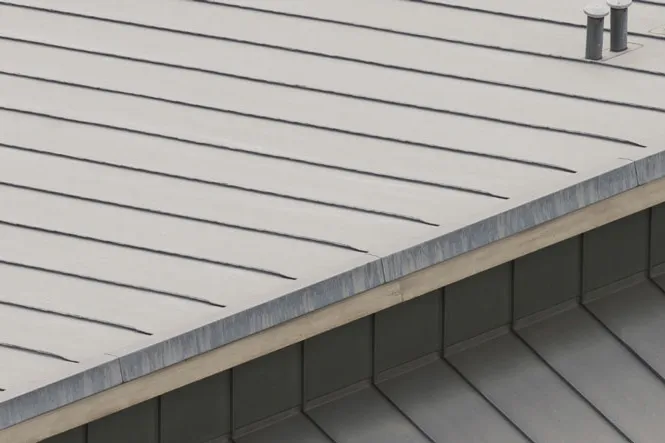
Metal on top cannot cure a warm attic, but it changes what happens at the surface. Standing seam panels can be one continuous length from the gutter line to the peak, so there is no end lap along the run. The clips that hold them hide under the seams rather than piercing the face. Backed-up water finds fewer openings, and the eave membrane underneath is still the backstop.
Seam choice matters where snow lingers. Sheffield Metals steers snowy regions toward mechanically seamed panels rather than snap-lock, since snow and ice that pile up and shift as temperatures swing can work snap-lock seams open. Our standing seam page explains both seam types.
Snow guards
Snow on smooth painted metal can let go in one slide onto a walkway, a porch roof or the gutters. Snow guards keep the load up top, where it can thaw gradually or drop off a little at a time.
On standing seam, the seam-clamp maker S-5! says its clamps fasten snow guards and similar gear to the seams with no holes in the roof, gripping each seam with setscrews. The attachment spacing has to be engineered for the roof and its loads, which is where the address-specific snow values above come in.
What should you do if an ice dam is leaking now?
Protect the inside first and leave the roof to a professional. Put buckets under drips, move valuables and take photos of the stains and the ice. Climbing onto an icy roof or chopping at the ice is dangerous and can damage the roofing and the gutters.
Once the weather allows, have the roof checked for damaged underlayment, decking and flashing; our roof repair service handles leaks like these. HomeGuide’s 2026 national ranges run $150 to $1,000 for a small leak and $1,000 to $3,000 once water has done some damage. Your exact price comes from a free measurement.
Leak repairs are taxable in New Jersey, while a full new roof can be an exempt capital improvement with Form ST-8, per the Division of Taxation. If the roof is due for replacement anyway, a new one with an eave membrane and open soffit-to-ridge vents fixes the roof side in one job.
Get a free estimate
Or call (732) 231-5327.
Ice dam questions
Is an eave membrane required by code in every New Jersey county?
No. Under DCA Bulletin 07-3, the code’s ice barrier requirement covers places where January’s mean daily temperature sits at or below 25 degrees F, and in New Jersey that means Sussex County alone. We still put one on every roof we install.
Is more attic ventilation enough to prevent ice dams?
No. Federal guidance from the Building America Solution Center ranks air sealing and insulation above ventilation, and Building Science Corporation calls venting a helper to good insulation rather than a replacement for it.
Does a standing seam roof prevent ice dams?
Not by itself. Ice dams come from heat reaching the roof deck, and no roofing material changes that. Standing seam does leave no end laps on a run and no screws through the face, and the eave membrane under it protects the deck while the attic is fixed.
Do gutters cause ice dams?
No. The ice ridge builds at the roof edge from meltwater that freezes again, and the gutters fill with ice as a result. Where snow lingers, the University of Illinois notes call for hangers every 16 to 24 inches and a gutter hung low enough for sliding snow to pass over it.
Is there help paying for attic insulation and air sealing in New Jersey?
The NJ Clean Energy Program lists a utility-run Whole Home Energy Solutions program for insulation and air sealing, plus no-cost weatherization for moderate-income customers. The federal 25C credit no longer applies to anything put in service after the end of 2025.
Sources
- University of Minnesota Extension, ice dam guidance for homeowners
- U.S. Department of Energy, Building America roof and attic guide
- Building Science Corporation, digest BSD-135
- Model residential code ventilation rules, R806 as adopted in California
- NJ Department of Community Affairs: Bulletin 07-3, Bulletin 19-1, Bulletin 22-1
- Rutgers, state climatologist overview
- NOAA NCEI, committee memo on the state snowfall record
- Sheffield Metals, article on steep-slope panels
- S-5!, seam clamp product page
- University of Illinois, 1990 gutter and downspout notes
- This Old House, gutter guard comparison
- NJ Clean Energy Program, utility efficiency programs; IRS, FAQ on the end of 25C
- HomeGuide, repair price ranges; NJ Division of Taxation, contractor tax bulletin S&U-3
Before the next snow
Get your roof edge ready for winter
We look at your eaves, soffit vents and ridge, point out attic issues, and quote a roof or repair with an eave membrane built in.