Seamless aluminum gutters
Seamless Gutters Sized for New Jersey Rain and Snow
Seamless gutters in NJ are formed from a coil of painted aluminum to the length of each run, so the long, straight stretches along your eaves have no joints to open up. We size them to the roof that drains into them, slope them toward the downspouts, and hang them to carry snow and ice.
- 5 on Google (12 reviews)
- Lifetime workmanship warranty for as long as you own the home
- Free written estimates
How they are made
How are seamless gutters made?
A seamless gutter starts as a flat coil of painted aluminum. A roll-forming machine shapes the coil into a gutter profile and cuts it to the length of the run. A straight run therefore has no end laps.
Englert’s seamless gutter catalog (Englert is based in Perth Amboy) shows how the sizes are made. A 5-inch K-style gutter is formed from coil 11-3/4 inches wide, and a 6-inch gutter from 15-inch coil. The machines are portable, and Englert’s specification calls for one continuous length on each elevation of the house.
Some joints remain. Corners, the outlets where downspouts connect, and end caps are still joined and sealed. Seamless cuts the number of joints sharply; it does not make a gutter leak-proof. Those few joints are the places to check after the first big storm.
Metal thickness
Should you choose .027 or .032 aluminum?
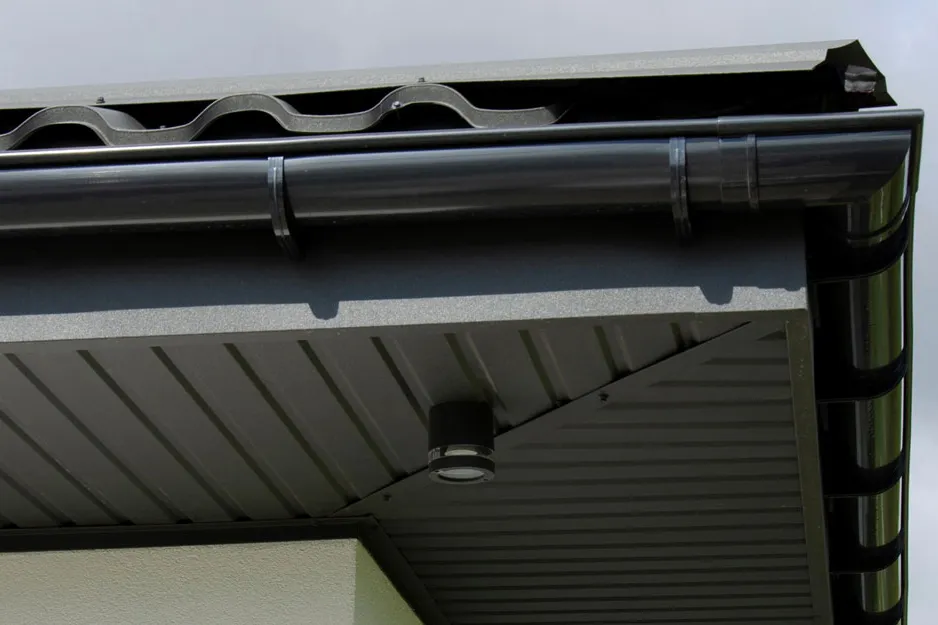
Both are standard residential gutter coil. The .032-inch coil is thicker and stiffer, which helps a long run hold its shape under ladders, branches and sliding ice. The .027-inch coil is the common baseline and costs less.
Englert sells residential aluminum gutter coil in both thicknesses, and Quality Edge’s aluminum specification lists gutter coil at 0.027 to 0.032 inch. A 1990 University of Illinois guide recommends at least 0.027-inch aluminum for gutters and 0.020 inch for downspouts.
Whichever you choose, it belongs in writing. New Jersey’s home improvement rules require a written contract over $500 to name the main products and materials, including size and grade where they apply (N.J.A.C. 13:45A-16.2). Our estimates list the thickness, size and color, so you can compare quotes line by line.
| Part | Common specification | Source |
|---|---|---|
| Gutter coil | .027 or .032 inch aluminum | Englert; Quality Edge |
| 5-inch K-style | Formed from 11-3/4 inch coil | Englert |
| 6-inch K-style | Formed from 15-inch coil | Englert |
| Downspouts | 2×3 or 3×4 inch aluminum | Englert; Illinois guide |
| Hanger spacing | 32 inches or less; 16 to 24 inches where snow and ice stay | Illinois guide |
| Slope | About 1/4 inch per 10 feet toward the outlet | Amerimax instructions |
| Expansion joints | On runs longer than 40 feet | Illinois guide |
Gutter size
Do you need 5-inch or 6-inch K-style gutters?
A 5-inch K-style gutter handles many smaller, simpler roofs. A 6-inch gutter carries more water and is the safer choice for large, steep or complex roofs and long runs.
The University of Illinois guide gives three tests. A 5-inch gutter is adequate only if the downspouts are less than 30 feet apart, the roof pitch is 9:12 or less, and the roof area drained is less than the gutter’s length in feet times 30. Miss any one, and the guide points to 6-inch.
Here is the third test in numbers. On a 28-foot run, a 5-inch gutter should drain less than 840 square feet of actual roof (28 times 30). The guide says to use real roof area, not the house footprint, because steeper roofs need bigger gutters.
The guide calls the K-style (ogee) shape the most common because of its looks and carrying capacity. Half-round gutters carry less, which matters if you are weighing copper half-round gutters. HomeGuide says 6-inch gutters add about $1 to $2 per linear foot. Our guide to 5-inch vs 6-inch gutters goes further.
Downspouts
How big should the downspouts be?
Size downspouts by roof area. A common rule is one square inch of downspout opening for every 100 square feet of roof. A 2×3-inch downspout (6 square inches) serves about 600 square feet, and a 3×4-inch about 1,200.
Amerimax’s installation instructions rate 2×3 downspouts at 186 gallons per minute and 3×4 at 434. Those are manufacturer figures without stated test conditions. Amerimax recommends larger or extra downspouts for wide roofs, heavy-downpour areas and gutters that overflow.
New Jersey gets those downpours. NOAA Atlas 14 estimates put a 10-year, 5-minute burst at New Brunswick at about 6.3 inches per hour. That is roughly three times the 10-year, 60-minute rate of about 2.0 inches per hour. Toms River (about 6.7 and 2.1) and Newton (about 6.3 and 1.9) are similar.
These are statistical design values: a 10-year storm has about a 10 percent chance of happening in any year. Short, heavy bursts are what overflow an undersized system. That is the case for a 3×4 downspout on a big roof plane, or an extra downspout on a long run.
Placement matters as much as size. The Illinois guide puts a downspout at each major corner and adds one in between where corners are more than 50 feet apart or the run is not straight. Each downspout should release water away from the foundation, not onto a walk that freezes.
Slope
How much slope does a gutter need?
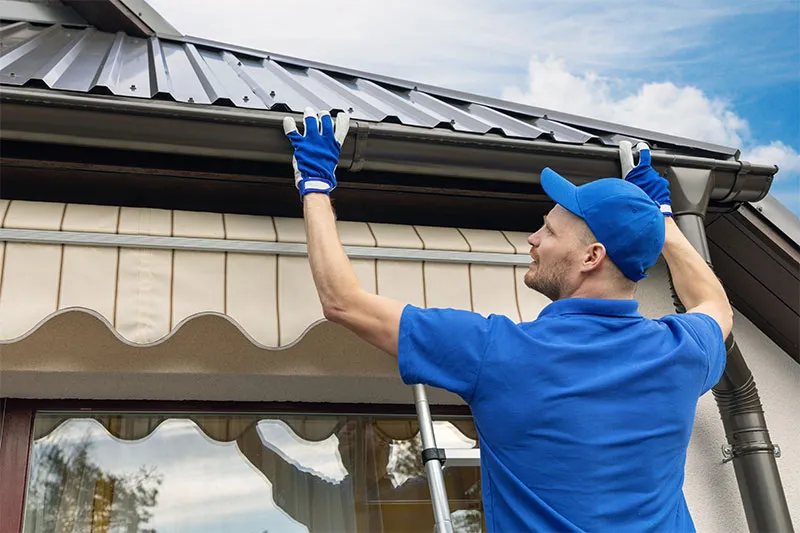
About 1/4 inch of drop for every 10 feet of gutter, toward the downspout. That is the slope Amerimax’s instructions call for: level a string line on the fascia, then lower it about 1/4 inch per 10 feet.
The Illinois guide notes gutters may also hang level where straight lines matter, as long as water does not stand in them. On a long run, the gutter can pitch from the middle toward a downspout at each end, which keeps the drop at either end small.
Height matters too. The back of the gutter should sit under the drip edge or gutter apron. In snow country, the guide says to set it low enough that a straightedge laid on the roof clears the gutter’s outer edge, so sliding snow and ice do not tear it loose.
Hangers and ice
How are seamless gutters hung for snow and ice?
Hidden hangers fasten the gutter to the fascia. For aluminum, the Illinois guide says supports should be no more than 32 inches apart, closing to 16 to 24 inches where snow and ice stay for much of the winter.
That spacing matters in the northern counties. The Office of the New Jersey State Climatologist puts average snowfall at 40 to 50 inches a year in the state’s northern zone.
Aluminum also grows and shrinks with temperature. The Illinois guide recommends expansion joints on gutter runs longer than 40 feet. Long seamless runs, such as across the front of a ranch house, are where this comes up.
Gutters do not cause ice dams, and hangers do not prevent them. Ice dams start with heat leaking into the attic; the fix is air sealing, insulation and ventilation through vented soffit. Our ice-dam guide explains the causes.
Fascia first
Does the fascia board matter?
Yes. The fascia carries every hanger, so a soft board will not hold a gutter, however well it is made. We check the fascia before we hang anything and repair rotted wood first.
HomeGuide notes that rotted fascia should be repaired before it is capped or before new gutters are hung. After repair, the board can be wrapped in aluminum trim coil. Our soffit and fascia page covers rot repair and capping.
Cost
How much do seamless gutters cost?
National cost guides put installed aluminum gutters at about $10 to $20 per linear foot, with seamless running $3 to $5 or more per foot above sectional. No published source gives a New Jersey figure.
- HomeGuide (2026): professionally installed gutters $12 to $25 per linear foot, or $2,200 to $5,000 for an average home; aluminum $10 to $20 per linear foot.
- Angi (2026): seamless aluminum $4 to $9 per linear foot for material plus $4 to $10 for labor, with an average project of about $1,150.
- HomeGuide add-ons: 6-inch gutters $1 to $2 more per foot, two-story homes $1 to $3 more per foot, downspouts $30 to $75 each, old gutter removal $50 to $200.
The guides measure scope differently, so treat them as a range, not a quote. HomeGuide says most homes have 100 to 200 linear feet of gutter. Your exact price comes from a free measurement.
Two more points. New gutters are an exempt capital improvement for New Jersey sales tax when you give the contractor Form ST-8, while repairs are taxable (NJ Division of Taxation). And InterNACHI lists aluminum gutters at 20 to 40-plus years with regular maintenance.
We give a written workmanship warranty, and the coil and finish makers warranty their materials. Our warranty page explains both.
Our workmanship warranty is a lifetime warranty: it covers our installation work for as long as you, the homeowner who signs the contract, own the home. It does not transfer to a later owner. Materials and paint finishes carry their manufacturers' own warranties, and the full written warranty comes with every estimate so you can read it before you sign.
Get a free estimate
Or call (732) 231-5327.
Seamless gutter questions
Are seamless gutters better than sectional gutters?
For most houses, yes. A seamless run has no joints along its length, while sectional gutters have a splice at every section. Fewer joints means fewer places to seal and re-seal. HomeGuide puts the premium at about $3 to $5 or more per linear foot.
Do seamless gutters ever leak?
They can. Corners, downspout outlets and end caps are still joined and sealed, and those are where leaks start. Seamless removes the joints along straight runs; it does not remove every joint.
Should I choose .027 or .032 aluminum?
Both are standard residential gutter coil. The .032-inch coil is stiffer, which helps on long runs and where ladders, branches or sliding ice can dent a gutter. The .027-inch coil costs less. Your written estimate should name the thickness either way.
Do I need 6-inch gutters?
A University of Illinois guide says 5-inch is adequate only when downspouts are under 30 feet apart, the pitch is 9:12 or less, and the roof area is less than the gutter length times 30. Larger, steeper or complex roofs usually need 6-inch.
How many downspouts does my house need?
A common rule of thumb pairs every 100 square feet of roof with one square inch of downspout opening, so a 2×3 serves about 600 square feet and a 3×4 about 1,200. The Illinois guide also puts one at each major corner and adds one where corners are more than 50 feet apart.
How much do seamless gutters cost in New Jersey?
National guides put installed aluminum gutters at about $10 to $20 per linear foot (HomeGuide, 2026), and Angi reports an average seamless project of about $1,150. There is no published New Jersey figure. Your exact price comes from a free measurement.
Can you install seamless gutters with a new roof?
Yes. Doing both together lets one crew set the gutter under the new drip edge, and one written contract covers the roof and the gutters. See our metal roofing options.
Free estimate
Get seamless gutters measured for your house
We measure each run and the roof above it, check the fascia, and give you a written price with the gutter size, thickness and downspouts spelled out.
Call (732) 231-5327 or send the form. We work across central and northern New Jersey; see our service areas.